☕ Support Us
Wars - 2023 10/08 Monitoring the Israel and Lebanon War | PKDefense

Wars 2023 10/08 Monitoring the Israel and Lebanon War

Reply (Scroll)
Press space to scroll through posts
G War Archive
Wars 2023 10/08 Monitoring the Israel and Lebanon War
186
7K
More threads by Saif


Israel ready for 'all-out war' in Lebanon
Say officials after Hezbollah releases threatening drone footage of the Israeli port city of Haifa

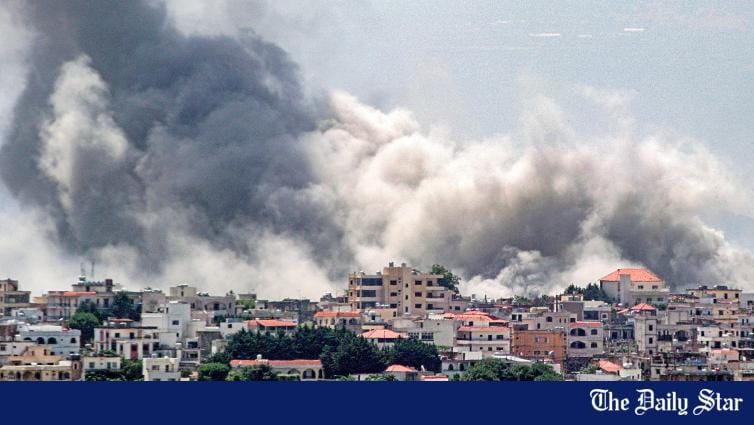
1718839048540.png


Israel is ready for an "all-out war" in Lebanon and has plans approved for an offensive targeting Hezbollah, officials said.

The claims from Israel's foreign minister and military late on Tuesday followed Hezbollah's release of threatening drone footage. The climbing tension conflicts with United States efforts to avert an escalation amid months of low-level hostilities across the Israel-Lebanon border.

The nine-minute drone footage of the Israeli port city of Haifa filmed in daytime, showed civilian and military areas, including malls and residential quarters, in addition to a weapons manufacturing complex and missile defence batteries.

Israel's Foreign Minister Israel Katz responded vehemently in a post on X, calling out Hezbollah chief Hassan Nasrallah for boasting about filming the ports of Haifa, which are operated by foreign companies from China and India.

"We are very close to the moment of decision to change the rules against Hezbollah and Lebanon. In an all-out war, Hezbollah will be destroyed and Lebanon will be severely hit," he wrote.

More than 400 people have been killed in Lebanon over the past eight months, with 25 deaths in Israel.

Later, the Israeli military said in a statement that Ori Gordin, head of its Northern Command, which includes the front line with Hezbollah, has approved plans to mount a ground assault across Israel's northern border, reports Al Jazeera online.

"As part of the situational assessment, operational plans for an offensive in Lebanon were approved and validated, and decisions were taken on the continuation of increasing the readiness of troops in the field," it said.

Israel and Hezbollah have been engaged in border fighting since the start of the offensive on Gaza on October 7. The confrontation is increasingly expanding, with both sides saying they are ready to go to war. Nasrallah has said in the past that Hezbollah will only stop its attacks if Israel halts its invasion of Gaza.

Hezbollah recently said that it has carried out more than 2,100 military operations against Israel since October 8 in what it says is an effort to support Palestinians.

More than 400 people have been killed in Lebanon over the past eight months, with 25 deaths in Israel. At least 90,000 people have been displaced in Lebanon, and more than 60,000 have been forced from their homes in northern Israel.​
 

Iran warns Israel of obliterating war if Lebanon attacked
Agence France-Presse . Tehran 29 June, 2024, 23:56

1719704668444.png

Supporters and activists of Islami Jamiat-e-Talaba take part in a demonstration to express their solidarity with the Palestinians, in Karachi Saturday amid the ongoing genocide of Palestinians by Israel. | AFP photo

Iran on Saturday warned that 'all resistance fronts', a grouping of Iran and its regional allies, would confront Israel if it attacks Lebanon.

The comment from Iran's mission to New York comes with fears of a wider regional war involving Israel and Lebanon's Iran-backed Hezbollah movement. The two sides have engaged in near-daily exchanges of fire since the war in Gaza began.

Such exchanges have escalated this month, alongside bellicose rhetoric from both sides. Israel's military said plans for a Lebanon offensive had been 'approved and validated', prompting Hezbollah to respond that none of Israel would be spared in a full-blown conflict.

In a post on social media platform X, the Iranian mission said it 'deems as psychological warfare the Zionist regime's propaganda about intending to attack Lebanon'.

But, it added, 'should it embark on full-scale military aggression, an obliterating war will ensue. All options, incl. the full involvement of all Resistance Fronts, are on the table.'

The war in Gaza began in October when Hamas Palestinian militants attacked southern Israel.

Iran, which backs Hamas, has praised the attack as a success but has denied any involvement.

Alongside Hezbollah's attacks on northern

Israel, Iran-backed rebels in Yemen have repeatedly struck commercial ships in the Red Sea area in what they say are acts of solidarity with the Palestinians.

Iran also backs other groups in the region.

The Islamic republic has not recognised Israel since the 1979 revolution that toppled Iran's United States-backed shah.

Fears of regional war also soared in April, after an air strike that levelled Iran's consulate in Damascus and killed seven Revolutionary Guards, two of them generals.

Iran hit back with an unprecedented drone and missile attack on Israel on April 13-14.

Iran's state media later reported explosions in the central province of Isfahan as US media quoted American officials saying Israel had carried out retaliatory strikes on its arch-rival.

Tehran downplayed the reported Israeli raid.​
 

10 Syrian refugees killed in Israeli strike on Lebanon
Agence France-Presse . Beirut 17 August, 2024, 23:41

1723941357975.png

Relatives mourn over the bodies of four members of the same family, including two children, killed in an Israeli strike in the Wadi al-Kafur area of the southern Lebanese Nabatiyeh district on Saturday. | AFP photo

Lebanon’s health ministry said an Israeli air strike on Saturday in southern Lebanon killed 10 Syrians, as the Israeli military reported hitting weapons stores of the Iran-backed Hezbollah movement.

The toll from the strike in the Wadi al-Kafur area of Nabatieh is one of the largest in southern Lebanon since Hezbollah and Israeli forces began exchanging near-daily fire over their border after war in the Gaza Strip began in October.

International mediators have been trying to reach a Gaza ceasefire between Israel and Hamas Palestinian militants, which diplomats say could help to avert a wider war in which Lebanon would be on the front line.

The death toll from the latest strike included ‘a woman and her two children’ while five other people were wounded, most of them also Syrian, Lebanon’s health ministry said in a statement.

The official Lebanese National News Agency reported that the casualties were Syrian refugees and workers.

Israel’s military, on its Telegram channel, said the air force had struck a weapons storage facility of Lebanon’s Hezbollah overnight ‘in the area of Nabatieh’, which is about 12 kilometres (seven miles) from the nearest point of the Israeli border.

Following the deaths in Wadi al-Kafur, Hezbollah said it responded with a volley of Katyusha rockets on Ayelet HaShahar, a community in northern Israel.

None of the roughly 55 projectiles caused any reported injuries but they sparked ‘multiple fires’, Israel’s military said.

Earlier, around 20 kilometres to the north ‘a projectile that crossed from Lebanon’ wounded two soldiers, one of them severely, in the Misgav Am area, Israel’s military said.

The killings in quick succession in late July of Fuad Shukr, a top operations chief of Hezbollah in south Lebanon, and Hamas political chief Ismail Haniyeh, led to vows of vengeance from Hezbollah, Iran and other Tehran-backed groups in the region which blamed Israel.

The cross-border violence between Lebanon and Israel has killed 580 people in Lebanon, mostly Hezbollah fighters but including at least 128 civilians, according to an AFP tally.

On the Israeli side, including in the annexed Golan Heights, 22 soldiers and 26 civilians have been killed, according to army figures.

Hezbollah and Israel fought a war in 2006.​
 

Hezbollah claims attacks on north Israel
Says two of its fighters killed

Lebanese group Hezbollah said yesterday two of its fighters were killed and claimed attacks on northern Israel, including with drones, the latest cross-border violence amid fears of full-blown war.

The powerful Iran-backed group has exchanged regular cross-border fire with Israeli army in support of ally Hamas since the Israeli offensive in Gaza began on October 7.

Hezbollah said two of its fighters were "martyred on the road to Jerusalem", the phrase it has used to refer to members killed by Israeli fire since October.

The Israeli military said air forces struck "Hezbollah terrorists" in the Hula area and "Hezbollah military structures" elsewhere in south Lebanon.

Lebanon media reported Israeli shelling and raids on several southern areas.​
 

Israel strikes on Lebanon kill 7
Agence France-Presse . Beirut 23 August, 2024, 23:02

Lebanon’s health ministry said on Friday Israeli strikes killed seven people including a child in different parts of the south, with Hezbollah saying three of its fighters were among the dead.

Hezbollah, which is backed by Iran, has exchanged regular fire with Israel in support of its ally Hamas since the Palestinian militant group’s October 7 attack on Israel sparked the Gaza war.

The health ministry said an ‘Israeli enemy drone strike’ killed two people including a ‘seven-year-old’ in Aita al-Shaab, and two other ‘Israeli’ strikes killed five people in three other locations in the south.

Lebanon’s state-run National News Agency said a ‘hostile drone’ targeted a house in Aita al-Shaab with ‘two guided missiles’.

The health ministry said Israeli strikes included a raid ‘on the village of Tayr Harfa that killed three people’, with Hezbollah later mourning three fighters killed by Israeli fire, including a man from that same village.

A source close to the group said that the three fighters were killed in the Tayr Harfa strike.

Israel’s military said its aircraft ‘eliminated’ members of ‘a terrorist cell that was planning to fire projectiles from the area of Tayr Harfa’.

On Friday morning, Hezbollah said it had targeted the northern Israel base of Meron ‘in response to the enemy’s attacks on southern villages and homes’.

The threat of full-blown war grew after Iran and Hezbollah vowed to avenge the killings last month, blamed on Israel, of Hamas political leader Ismail Haniyeh in Tehran and top Hezbollah commander Fuad Shukr in south Beirut.

Cross-border violence since the Gaza war started has killed 600 people in Lebanon, mostly Hezbollah fighters but including at least 131 civilians, according to an AFP tally.

The Israeli authorities have announced the deaths of at least 23 soldiers and 26 civilians since the escalation began.​
 

UN peacekeepers worried in south Lebanon crossfire
Agence France-Presse . Palestine 24 August, 2024, 23:10

On the deserted border between Lebanon and Israel, Spanish UN peacekeepers have for more than 10 months effectively been caught in a war zone.

Several Blue Helmets have been wounded in the crossfire between Israel and Lebanon’s Hezbollah movement, which has also left dozens of Lebanese civilians dead in fallout from the war between Israel and Palestinian militants in Gaza.

‘Sometimes we need to shelter because of the shelling... sometimes even inside the bunkers,’ said Alvaro Gonzalez Gavalda, a Blue Helmet at Base 964 of the United Nations Interim Force in Lebanon.

To reach the base, AFP journalists escorted in a UNIFIL convoy passed through virtually deserted villages. Only the occasional grocer or automotive repair shop were still open along the road where fields have been left charred by bombardment.

The base, surrounded by barbed wire and protected with heavy stone-filled berms, is not far from the town of Khiam, where dozens of houses have been destroyed or damaged, about five kilometres (three miles) from the border.

Over a wall that marks the frontier, the Israeli town of Metula is clearly visible. It has also been emptied of residents, as have other communities on both sides of the boundary.

From a watchtower, binoculars help the peacekeepers see further—into the Golan Heights annexed by Israel. The area has been a frequent target of Hezbollah fire.

Spanish Lieutenant Colonel Jose Irisarri said their mission, under Security Council Resolution 1701, is to ‘control the area’ and help the Lebanese government and armed forces establish control south of the Litani River, which is around 30 kilometres from the border with Israel.

The resolution ended a war between Israel and Hezbollah in 2006.

It called for all armed personnel to pull back north of the Litani, except for Lebanese state security forces and United Nations peacekeepers.

While Hezbollah has not had a visible military presence in the border area since then, the group still holds sway over large parts of the south.

When Hamas militants from the Gaza Strip attacked Israel on October 7, triggering war with Israel, Hezbollah opened what it calls a ‘support front’ a day later, launching rockets and other fire from southern Lebanon against Israeli positions.

Israel has hit back with air strikes and artillery fire.

‘Some of these villages are completely empty. There is no one living there because of the risk and the constant attacks they are suffering,’ Irisarri said.

The Security Council first established UNIFIL in 1978 after Israel invaded south Lebanon. Its mission was expanded after the 2006 war.

Now, with fears of a wider regional war in which Lebanon would be on the front line, the UN’s Under Secretary-General for Peace Operations Jean-Pierre Lacroix said UNIFIL’s role is ‘more important than ever’.

Spain’s contingent of 650 soldiers, based at several positions, are among around 10,000 troops from 49 countries in the mission.

‘It’s the only liaison channel between the Israeli side and the Lebanese side in all its components, such as Hezbollah,’ Lacroix told AFP in early August.

UNIFIL’s mandate expires at the end of August and Lebanon has asked for its renewal.

Cross-border violence since the Gaza war started has killed 601 people in Lebanon, mostly Hezbollah fighters but also including at least 131 civilians, according to an AFP tally.

The Israeli authorities have announced the deaths of at least 23 soldiers and 26 civilians since the fighting began, including in the annexed Golan Heights.

The Spaniards don’t just limit themselves to their core mission. They also give ‘support and some help’ to the local population, Irisarri said.

As an example, he said their psychological team assists students with special needs.

AFP was unable to visit the school during its tour on Friday, after the Spanish contingent raised the security level following exchanges of fire in the area.

Israeli strikes in Lebanon’s south on Friday killed seven Hezbollah fighters and a local child, according to Hezbollah and Lebanon’s health ministry. Israel said its military aircraft had hit ‘terrorist’ targets.

The peacekeepers have little time to rest, but have the company of two adopted dogs.

When they do have leisure time, ‘we go to the gym to keep fit and also we enjoy watching movies and talking to some friends’, said Gavalda.

He has been in Lebanon since May.

‘We miss our families,’ but internet enables them to stay in touch almost daily, Gavalda said.

Surrounded by death, the soldiers have set up on their grounds a small statue of the Virgin Mary inside a protective glass case.​
 

Members Online

No members online now.

Latest Posts

Latest Posts