Bangladesh Defense
Krishna with Flute
Senior Member
- Joined
- Jan 26, 2024
- Messages
- 4,865
- Likes
- 2,577
- Axis Group

A shikh saint Revive a river. Report.
Jump to navigationJump to search
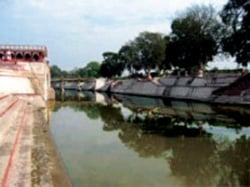
Kali Bein At Sultanpur Lodhi
The Kali Bein also known as the Kali Beiri, a river in the Hoshiarpur district of Punjab, which holds a very sacred part in every Sikh's heart, has been given a new life by a more than 6 year long effort begun by Sant Balbir Singh Sancherwal in 2000.
By drawing on the Sikh tradition of kar sewa (free voluntary service) and Daswandh (common donation of 10%), he and his followers taught locals people why they should clean the Kali Bein, enlisting volunteers to do the physical work and raising funds for equipment. At the height of his movement, people from more than two dozen villages were pitching in.
The scale of the task was gigantic — volunteers cleared the entire riverbed of water hyacinth and silt, and built riverbanks and roads alongside the river. When appeals to government and municipal bodies failed to stop dirty water flowing into the river, Seechewal launched a public-awareness campaign to encourage villagers to dispose of their sewage elsewhere.
Some villages revived traditional methods of waste disposal and treatment, and farmers lined up for a share of the treated water. A government order to divert water from a nearby canal was eventually obtained. As the riverbed was cleared, natural springs revived and the river began to fill up. Since then, trees have been planted along its banks and fishing has been banned to preserve biodiversity.
Two days later when he reappeared 2 km upstream, at a spot now known as "Sant Ghat", his first utterance was “Naa ko Hindu na Musalmaan” - "There is no Hindu, there is no Musalman". It was here along the Kali Bein that Guruji composed the Japji Sahib (containing the Mool Mantar) and from here that he undertook his first two Udasis (religious journeys).
All of this happened on the banks of the river where Gurdwara Ber Sahib now stands by the side of the old ber tree believed to be the same tree under which Guru ji sat in meditation at Sultanpur Lodhi. This Gurdwara was built as a tribute to the father of Sikhi who with his family and Sister Bebe Nanaki Ji lived here for nearly 14 years.

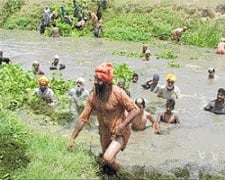
With their hands Sancherwal and others labour to restore the Kali Bein
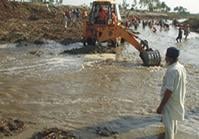
Industrial Machinery added to the efforts
Through kar seva he and thousands have in a labour of love of untold hours cleaned the river. These efforts were noticed and now even governments along the way have jumped into the effort and now even weed technology-based ponds are being introduced in many out of 64 villages across the Bein's length to allow villagers to treat water before releasing it into the rivulet. Additionally sewage treatment plants for major cities along the way are being planned. The two crore plant in Sultanpur Lodhi is ready, the one in Kapurthala, an Rs 10 crore project, is in final stages. And plants will soon be set up at Tanda, Begowal and other industrial towns along the length of the Bein.
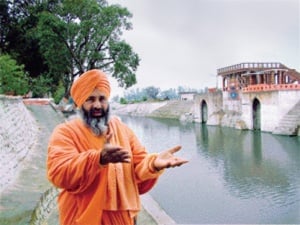
Sant Sancherwal alongside the Beautiful Kali Bein
Today, the river’s banks have been raised, inflows of waste, plugged, the river-bed desilted and flowering plants, once again, align its length. The Kali Bein is once again clear and flowing!
UNI reports that, in the next few months President Kalam is to visit the river to honour Sant Sancherwal.
Up date from News reports:
In a recent headline, The Indian president, on a visit to Greece has praised a Sikh Saint for cleaning an entire river with sewa (voluntary service).Kalam hails Sikh priest’s work
While on a trip to Greece , President A P J Abdul Kalam praised the work of a Sikh priest in Punjab who had cleaned up a “polluted and choked” local river to illustrate how the art of “giving” by individuals and nations could promote happiness around the world.
Although a small river, the Kali Bein, with the sewage of 43 villages and towns, apart from the effluents of many factories turning it into a weed-choked dirty drain, shares its miserable plight with most of our bigger rivers. A thick layer of silt has settled over its bed, blocking its pores that could help recharge the water table.
As a result, two districts of the Doaba region suffered in their own different ways. While a vast tract of land in Mukerian tehsil of Hoshiarpur became water-logged, almost the whole of Bhulath and Sultanpur Lodhi tehsils of Kapurthala district underwent a fast depletion of the water table.
Water that seeped underground contaminated the ground water and set in an unending process of slow poisoning of the people whose lives largely depended on it.
In the second phase, hyacinth and silt were cleared out of the Kali Bein from Dhanoa in Hoshiarpur district to Kanjali in Kapurthala district, and a kutcha road was prepared from Dhanoa to Kanjali, measuring about 110 kilometres along the Bein.
In the third phase (2004-05) the kar sewa was resumed at Sultanpur Lodhi to the West of Talwandi bridge, removing hyacinth and silt from the bed of the Bein. Work was also extended to the residential area of Sultanpur Lodhi, installing sewerage systems.
In the fourth phase (2006-07), the kar sewa entered a new stage, which surprised many. Sant Seechewal saw that if the river is de-silted from Harike upward to Sultanpur Lodhi, then it was easy to bring the Beas water upward. This plan was realised with the cooperation of the people of the Mand area.
During the current phase, (2006 to 2008), the kar sewa has acquired still newer dimensions. In order to restore the purity of the Holy Bein permanently, alternative arrangements for sewage are being made. Treated sewage is being supplied through pipelines for irrigation of crops.
The kar sewa has opened new economic vistas for the people of Punjab. Water flow has been restored. About 6000 acres of water-logged land in Hoshiarpur have been reclaimed. In Kapurthala, 1,35,000 hectares of land have been saved from depletion of the water table. The roads along the banks have brought people and places closer and paved the way for faster development.
Sant Balbir Singh Seechewal and his kar sewak followers have proved that collective efforts can work wonders.
Bhai Mohinder Singh, GNNSJ Birmingham,UK
Baba Balbir Singh Seechewal, who has taken up the task of cleaning Bein river. He conducted meetings with NRIs in UK during his 20-day visit over the issue.
The villagers want to construct a gurdwara at the place and they are maintaining that the place is associated with the first Guru of the Sikhs, Guru Nanak Dev.
Bhai Sahib Bhai Mohinder Singh is the mukhi-Sewadar (the main volunteer) of the Sikh organisation called Guru Nanak Nishkam Sewak Jatha, which has its head office in Birmingham, UK. He has been linked to this organisation since 1974 when he met the founder and spiritual inspiration of the organisation, Sant Baba Puran Singh, Kericho-wala in Kenya. Bhai sahib is a graduate of a UK university and professionally recognised as an excellent civil engineer. He has undertaken many large scale projects involving the construction of petroleum refineries in the 70's and 80's and then large-scale housing project in Africa and in particular Zambia. Bhai sahib was living in Zambia when he first met Baba Puran Singh ji and so Bhai sahib ji was fondly known as "Zambia-wala Bhai Sahib" in the 80's and early 90's by members of the Sangat.
In 1995 that Bhai Sahib was called to take on the responsibilities of this Jatha (organisation) when Bhai Norang Singh passed away suddenly in early 1995. His first main task was to successfully complete the UK sangat's project of re-gilding the Sri Harimandir Sahib. Since those times, with Bhai sahibs energy and dedication and Waheguru's kirpa, the Sangat and Jatha have completed many important projects of the Panth.
One of Bhai sahib recent developments has been the involvement of the Sangat in further Interfaith dialogue. In this respect, the Jatha has been involved with CPWR , Religions for Peace, UN NGO Programmes, etc. In 2004, the efforts of Bhai sahib resulted in a first for Sikhi when on the occasion of the 400th celebration of the first prakash (installation) of Sri Guru Granth Sahib, the Jatha took part in the Forum 2004 in Barcelona. The legacy of the event was the serving of Langar to the many thousand who attended the Interfaith Conference. This was a most gratifying undertaking and all who took part remember it with fond memory and utter praise on the Guru for blessing of such Sewa.
Not only had he stopped the flow of fresh water into the historic bin, but BJP MLA Amarjit Sahi had allegedly even questioned the religious and historical significance of the rivulet.
Akal Takht, SGPC want fresh flow | India News - Times of India
Kali Bein, Kar Sewa Restores the Historic River
Jump to navigationJump to search

Kali Bein At Sultanpur Lodhi
The Kali Bein also known as the Kali Beiri, a river in the Hoshiarpur district of Punjab, which holds a very sacred part in every Sikh's heart, has been given a new life by a more than 6 year long effort begun by Sant Balbir Singh Sancherwal in 2000.
By drawing on the Sikh tradition of kar sewa (free voluntary service) and Daswandh (common donation of 10%), he and his followers taught locals people why they should clean the Kali Bein, enlisting volunteers to do the physical work and raising funds for equipment. At the height of his movement, people from more than two dozen villages were pitching in.
The scale of the task was gigantic — volunteers cleared the entire riverbed of water hyacinth and silt, and built riverbanks and roads alongside the river. When appeals to government and municipal bodies failed to stop dirty water flowing into the river, Seechewal launched a public-awareness campaign to encourage villagers to dispose of their sewage elsewhere.
Some villages revived traditional methods of waste disposal and treatment, and farmers lined up for a share of the treated water. A government order to divert water from a nearby canal was eventually obtained. As the riverbed was cleared, natural springs revived and the river began to fill up. Since then, trees have been planted along its banks and fishing has been banned to preserve biodiversity.
Contents
- 1A Shocking Disappearance
- 2Some History
- 3400 Hundred years of Public Neglect and Indifference
- 4Situation Today
- 5Recent history of the river
- 6The four phases
- 7The President of India visits the river and completion
- 8GNNSJ, UK donated Rs 60 lakh to clean the Bein river
- 9April 2011, Kali Bein drying up
- 10See also
- 11External Links
A Shocking Disappearance
Guru Nanak performed his morning ablutions in thi Bein and would then set by a "bear" tree he had planted and meditate. Guru ji meditated here for 14 years, nine months and 13 days. It was during one such ablution that Guru Nanak had what is described, in the Janam Sakhis, as a direct communion with the Divine. Five centuries ago as Guru Nanak went for his daily bath in the rivulet he disappeared. His friends and followers feared he had drown, his detractors started rumours that he had robbed his employer's stores and run away.Two days later when he reappeared 2 km upstream, at a spot now known as "Sant Ghat", his first utterance was “Naa ko Hindu na Musalmaan” - "There is no Hindu, there is no Musalman". It was here along the Kali Bein that Guruji composed the Japji Sahib (containing the Mool Mantar) and from here that he undertook his first two Udasis (religious journeys).
All of this happened on the banks of the river where Gurdwara Ber Sahib now stands by the side of the old ber tree believed to be the same tree under which Guru ji sat in meditation at Sultanpur Lodhi. This Gurdwara was built as a tribute to the father of Sikhi who with his family and Sister Bebe Nanaki Ji lived here for nearly 14 years.
Some History

With their hands Sancherwal and others labour to restore the Kali Bein
- The 160-km-long river springs from the land around Dhanao village in the Hushiarpur district of the Punjab. Their the minerals that seep into the river have lent the river its name as they cause the river to give a black reflection in the viewers eye.
- In the Glory days of Emperor Akbar, who was more concerned with beauty than with forcing Islam on his subjects, some stretches of the rivulet's upper banks were lined with bricks and planted with beds of flowers, bushes and trees along its sides making it a place of beauty.
- Once the river merged in the confluence of the Beas and the Ravi, but the Beas changed its bed and the Kali Bein fell on hard times.
400 Hundred years of Public Neglect and Indifference

Industrial Machinery added to the efforts
- In the rainy season public indifference had allowed it to became a cesspool with village, city and industrial wastes from even a railway factory in Kapurthala filling it and clogging its once beautiful black waters with masses of ugly weeds and sewage.
Through kar seva he and thousands have in a labour of love of untold hours cleaned the river. These efforts were noticed and now even governments along the way have jumped into the effort and now even weed technology-based ponds are being introduced in many out of 64 villages across the Bein's length to allow villagers to treat water before releasing it into the rivulet. Additionally sewage treatment plants for major cities along the way are being planned. The two crore plant in Sultanpur Lodhi is ready, the one in Kapurthala, an Rs 10 crore project, is in final stages. And plants will soon be set up at Tanda, Begowal and other industrial towns along the length of the Bein.
Situation Today

Sant Sancherwal alongside the Beautiful Kali Bein
Today, the river’s banks have been raised, inflows of waste, plugged, the river-bed desilted and flowering plants, once again, align its length. The Kali Bein is once again clear and flowing!
UNI reports that, in the next few months President Kalam is to visit the river to honour Sant Sancherwal.
Up date from News reports:
In a recent headline, The Indian president, on a visit to Greece has praised a Sikh Saint for cleaning an entire river with sewa (voluntary service).Kalam hails Sikh priest’s work
While on a trip to Greece , President A P J Abdul Kalam praised the work of a Sikh priest in Punjab who had cleaned up a “polluted and choked” local river to illustrate how the art of “giving” by individuals and nations could promote happiness around the world.
Recent history of the river
Apart from the Kali Bein having a holy connection with Guru Nanak Dev, it is the lifeline of the Doaba region of Punjab. Thanks to the rapid growth of population and urbanisation over the decades, it had become utterly polluted. Sant Balbir Singh Seechewal launched his kar sewa in July 2000, to revive the dying river.Although a small river, the Kali Bein, with the sewage of 43 villages and towns, apart from the effluents of many factories turning it into a weed-choked dirty drain, shares its miserable plight with most of our bigger rivers. A thick layer of silt has settled over its bed, blocking its pores that could help recharge the water table.
As a result, two districts of the Doaba region suffered in their own different ways. While a vast tract of land in Mukerian tehsil of Hoshiarpur became water-logged, almost the whole of Bhulath and Sultanpur Lodhi tehsils of Kapurthala district underwent a fast depletion of the water table.
Water that seeped underground contaminated the ground water and set in an unending process of slow poisoning of the people whose lives largely depended on it.
The four phases
During the first phase of the kar sewa of the Holy Bein (2000-2003), the river was cleared of water hyacinth and silt at the historical town of Sultanpur Lodhi. Both its banks were raised and lined with boulders to build beautiful bathing ghats. Bricked roads along the banks were prepared and beautified with decorative and fruit trees. Water supply, sewerage and power supply systems were installed.In the second phase, hyacinth and silt were cleared out of the Kali Bein from Dhanoa in Hoshiarpur district to Kanjali in Kapurthala district, and a kutcha road was prepared from Dhanoa to Kanjali, measuring about 110 kilometres along the Bein.
In the third phase (2004-05) the kar sewa was resumed at Sultanpur Lodhi to the West of Talwandi bridge, removing hyacinth and silt from the bed of the Bein. Work was also extended to the residential area of Sultanpur Lodhi, installing sewerage systems.
In the fourth phase (2006-07), the kar sewa entered a new stage, which surprised many. Sant Seechewal saw that if the river is de-silted from Harike upward to Sultanpur Lodhi, then it was easy to bring the Beas water upward. This plan was realised with the cooperation of the people of the Mand area.
The President of India visits the river and completion
On 17August 2006, President of India, A.P.J. Abdul Kalam came to visit the Kali Bein at Sultanpur Lodhi .During the current phase, (2006 to 2008), the kar sewa has acquired still newer dimensions. In order to restore the purity of the Holy Bein permanently, alternative arrangements for sewage are being made. Treated sewage is being supplied through pipelines for irrigation of crops.
The kar sewa has opened new economic vistas for the people of Punjab. Water flow has been restored. About 6000 acres of water-logged land in Hoshiarpur have been reclaimed. In Kapurthala, 1,35,000 hectares of land have been saved from depletion of the water table. The roads along the banks have brought people and places closer and paved the way for faster development.
Sant Balbir Singh Seechewal and his kar sewak followers have proved that collective efforts can work wonders.
Bhai Mohinder Singh, GNNSJ Birmingham,UK
- NRI, GNNSJ Birmingham, UK donated Rs 60 lakh to clean the Bein river in Punjab London, Aug. 15, 2007, Sant Singh
Baba Balbir Singh Seechewal, who has taken up the task of cleaning Bein river. He conducted meetings with NRIs in UK during his 20-day visit over the issue.
The villagers want to construct a gurdwara at the place and they are maintaining that the place is associated with the first Guru of the Sikhs, Guru Nanak Dev.
Bhai Sahib Bhai Mohinder Singh is the mukhi-Sewadar (the main volunteer) of the Sikh organisation called Guru Nanak Nishkam Sewak Jatha, which has its head office in Birmingham, UK. He has been linked to this organisation since 1974 when he met the founder and spiritual inspiration of the organisation, Sant Baba Puran Singh, Kericho-wala in Kenya. Bhai sahib is a graduate of a UK university and professionally recognised as an excellent civil engineer. He has undertaken many large scale projects involving the construction of petroleum refineries in the 70's and 80's and then large-scale housing project in Africa and in particular Zambia. Bhai sahib was living in Zambia when he first met Baba Puran Singh ji and so Bhai sahib ji was fondly known as "Zambia-wala Bhai Sahib" in the 80's and early 90's by members of the Sangat.
In 1995 that Bhai Sahib was called to take on the responsibilities of this Jatha (organisation) when Bhai Norang Singh passed away suddenly in early 1995. His first main task was to successfully complete the UK sangat's project of re-gilding the Sri Harimandir Sahib. Since those times, with Bhai sahibs energy and dedication and Waheguru's kirpa, the Sangat and Jatha have completed many important projects of the Panth.
One of Bhai sahib recent developments has been the involvement of the Sangat in further Interfaith dialogue. In this respect, the Jatha has been involved with CPWR , Religions for Peace, UN NGO Programmes, etc. In 2004, the efforts of Bhai sahib resulted in a first for Sikhi when on the occasion of the 400th celebration of the first prakash (installation) of Sri Guru Granth Sahib, the Jatha took part in the Forum 2004 in Barcelona. The legacy of the event was the serving of Langar to the many thousand who attended the Interfaith Conference. This was a most gratifying undertaking and all who took part remember it with fond memory and utter praise on the Guru for blessing of such Sewa.
JALANDHAR: The SGPC and the Akal Takht on Wednesday demanded that the Punjab government release fresh water into the Kali Bein to save it.Not only had he stopped the flow of fresh water into the historic bin, but BJP MLA Amarjit Sahi had allegedly even questioned the religious and historical significance of the rivulet.
Akal Takht, SGPC want fresh flow | India News - Times of India
@Saif
Last edited: