India's Northeast, historically vulnerable due to its geography and demographic complexity, faces an urgent and

frontierindia.com
Tri-Nation Strategy: How China, Pakistan, and Bangladesh COULD Redraw India’s Eastern Frontier
India’s Northeast faces a mounting strategic threat from a covert China-Pakistan-Bangladesh axis, converging militarily, demographically, and ideologically to destabilize the region. Urgent, multi-pronged countermeasures are essential to safeguard national integrity and preempt a potential three-front conflict.
By
Lt Col Manoj K Channan
2025-04-09
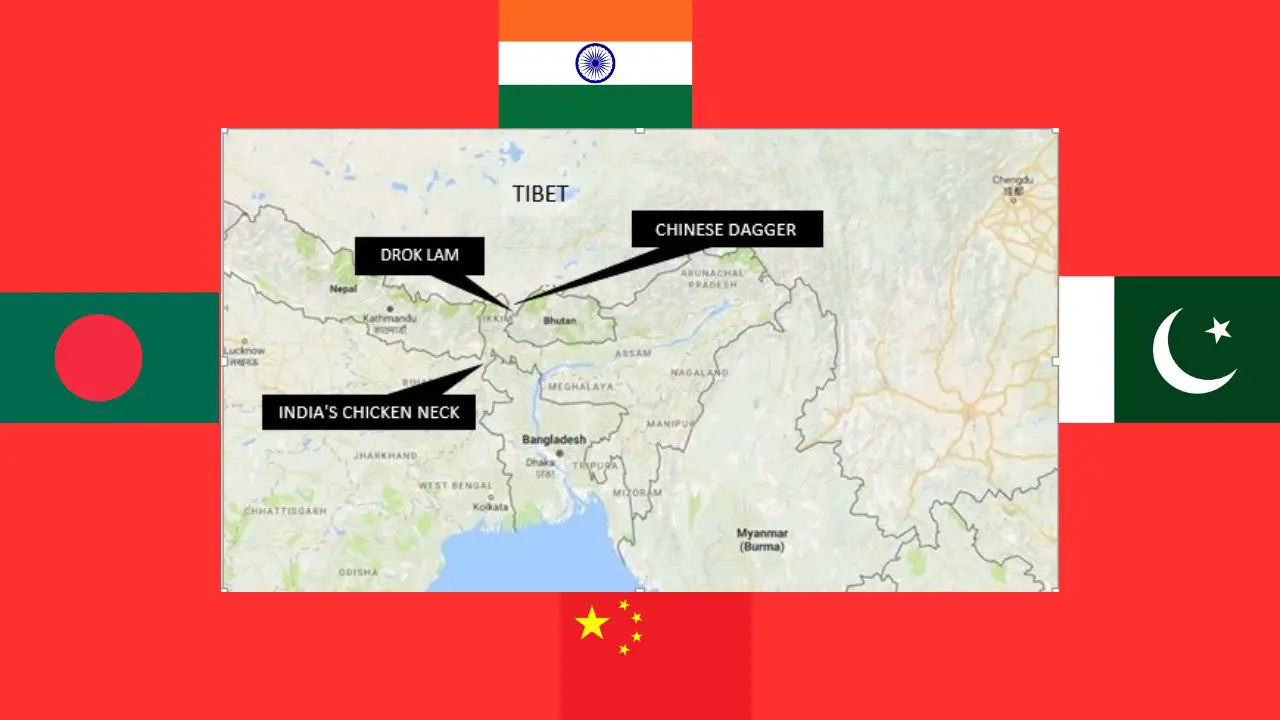
India’s Northeast, historically vulnerable due to its geography and demographic complexity, faces an urgent and complex threat. A silent yet strategic realignment is underway among China, Pakistan, and Bangladesh—three countries that have historically posed direct or indirect threats to Indian security. The convergence of their actions, from infrastructure development near sensitive corridors to renewed diplomatic and military engagement, is not coincidental. It signals a calculated regional strategy that could destabilize India’s eastern frontier, necessitating immediate attention and action.
Recent developments involving China, Pakistan, and Bangladesh connect the dots and evaluate the implications for India, especially for the fragile and strategically critical Northeast region. The emerging tri-nation axis presents India with a complex and multidimensional military, demographic, and ideological threat, the understanding of which is crucial for devising effective countermeasures.
Key Developments and Strategic Moves
China’s New Airbase Near the Siliguri Corridor
China’s construction of a new airbase close to the Siliguri Corridor—India’s narrow land link to the Northeast—is a serious security concern. Positioned near Doklam, the site of the 2017 India-China standoff, this base strengthens Beijing’s southern access to the corridor. A conflict could choke the Siliguri Corridor (or “Chicken’s Neck”), cutting off seven Northeast Indian states. The area is already under stress due to demographic shifts, including undocumented migration from Bangladesh.
Chinese Footprint in Bangladesh’s Infrastructure and Health Sectors
The development of the Matarbari Deep Sea Port and Mongla Port with Chinese assistance gives Beijing more significant access to the Bay of Bengal and the possibility of dual-use military infrastructure under civilian cover. In parallel, significant Chinese investment in Bangladesh’s health sector indicates an attempt to win soft power influence and a strategic foothold under the guise of humanitarian development.
Massive Chinese Financial Infusion
China’s injection of $2.1 billion into Bangladesh’s economy isn’t charity—it’s strategy. Beijing is buying influence, loyalty, and future leverage. Infrastructure projects funded by Chinese money often include clauses that lead to debt traps and eventual strategic control, similar to what has been seen in Sri Lanka and parts of Africa.
Renewed Pakistan-Bangladesh Engagement
Recent visits by Pakistani military, business, and political delegations to Bangladesh mark a sharp uptick in bilateral ties. The visit of a Pakistani ISI team, which included a Major General, to military bases in Bangladesh raises concerns about potential intelligence collaboration or strategic planning. Business ties, too, are a smokescreen for deeper political and ideological alignment.
Military Exchanges and Political Provocations
A Bangladeshi military delegation visiting Islamabad suggests growing defense collaboration. Furthermore, following the meeting between Prime Minister Modi and Nobel Laureate Muhammad Yunus, Bangladesh’s formal extradition request for Sheikh Hasina seems politically loaded. Yunus, in turn, made unusually harsh statements against India, perhaps reflecting the sentiment of rising anti-India factions within Dhaka’s power corridors.
Rohingya Factor
Bangladesh has become a staging ground for the dispersal of Rohingya refugees into India. Many are now present in sensitive areas like Jammu & Kashmir and Delhi. Their presence raises humanitarian concerns and creates security vulnerabilities, as radical elements could exploit these communities.
Emerging Pattern: A Tri-Nation Axis
The pattern emerging from these actions points to a more profound, more coordinated effort among China, Pakistan, and Bangladesh to undermine India’s stability from the East. This phenomenon is not merely diplomatic engagement—it’s strategic encirclement.
China brings military might, technological superiority, and financial muscle.
Pakistan offers intelligence expertise and ideological alignment through radical networks.
Bangladesh, increasingly influenced by Jamaat-e-Islami and pro-Islamist factions, is the geographical and demographic bridgehead to India’s northeast.
Together, they form a triangle of influence that, if unchecked, could provoke instability at India’s borders and deep within.
Ramifications for the Northeast
Rising Hostility and Proxy Threats
The most immediate risk is an uptick in cross-border militancy and internal insurgency. Foreign funds and ideological support may reactivate groups dormant in the Northeast. Intelligence inputs suggest that factions in Manipur, Assam, and Nagaland are already under scrutiny for renewed external contacts.
Demographic Engineering and Internal Destabilization
The influx of illegal immigrants, particularly Rohingyas, is altering the demographic balance in key states like Assam and Tripura. External actors will likely exploit these shifts to intensify ethnic tensions, create pressure on local resources, and ignite conflict.
Exploitation of Ethnic Fault Lines
The Northeast is a patchwork of ethnic identities—Kukis, Nagas, Bodos, Chakmas, Meiteis, and others—many of whom have historic grievances. China, Pakistan, and now Bangladesh may seek to inflame these divisions.
The Kuki-Zomi crisis in Manipur could be deepened with Myanmar-based support.
The Chakmas, marginalized in Arunachal Pradesh, could be radicalized with backing from Bangladesh-based networks.
In Meghalaya and Mizoram, where anti-center sentiments simmer, external influence could widen fault lines.
Threats to Infrastructure and Development
Strategic infrastructure like roads, railways, and defense installations in the Northeast could become soft targets. Hostile neighbors have always sought to disrupt connectivity between the Northeast and the Indian mainland—expect sabotage, cyberattacks, and low-intensity conflicts aimed at infrastructure.
Ideological Penetration
Radical Islamist ideologies could gain ground in border regions. Institutions funded or influenced by overseas entities might become platforms for anti-India sentiment, fostering unrest and youth radicalization.
India’s Strategic Response
India must urgently adopt a proactive, layered approach to counter these challenges. In the current situation, where the threat is both emerging and evolving, such proactive measures are vital.
Strengthen the Siliguri Corridor
Militarize and modernize this vulnerable strip with air defense systems, rapid troop deployment facilities, and high surveillance infrastructure.
Expand Intelligence Capabilities
Establish a comprehensive network to monitor external and internal actors and track the movement of people, arms, and funds.
Border Fencing and Smart Surveillance
Complete fencing along the Bangladesh border and deploy smart sensors, drones, and AI-powered monitoring systems.
Activate Northeast Diplomacy
Engage with local leaders and communities to integrate them more strongly with India’s national narrative. Develop Northeast-centric policy frameworks for economic and cultural empowerment.
Counter-Narrative to Islamist Propaganda
Strengthen civil society, moderate religious institutions, and promote inter-community dialogues to inoculate the region against radicalisation.
Disrupt the China-Pakistan-Bangladesh Axis
Launch diplomatic offensives in regional and global forums to expose growing collusion. Strengthen ties with Bhutan, Nepal, and Myanmar to create counterbalances.
Nuclear and Conventional Military Preparedness
Prepare for a multi-front conflict. Deploy nuclear assets and ramp up conventional military capability in the Eastern theater to ensure adequate deterrence.
Conclusion
The writing is on the wall. India is being strategically encircled—not just from the north and west, but also from the east. The China-Pakistan-Bangladesh axis represents a new phase in regional hostility, driven by a blend of strategic ambition, ideological alignment, and opportunistic politics. The stakes for India, particularly its Northeast, are significant. Economic competition and the ability to secure internal unity against coordinated external subversion will define the next decade.

 Bangladesh Defense