☕ Support Us
[🇧🇩] - Footwear, Rubber and leather Industry in Bangladesh | Page 3 | PKDefense

[🇧🇩] Footwear, Rubber and leather Industry in Bangladesh

Reply (Scroll)
Press space to scroll through posts
G Bangladesh Defense
[🇧🇩] Footwear, Rubber and leather Industry in Bangladesh
64
4K
More threads by Bilal9


Compliance issues get in way of fully tapping leather export potential: Labour secretary
FE ONLINE REPORT
Published :
Sep 26, 2024 20:29
Updated :
Sep 26, 2024 21:42
Share this news

1727398492617.png


Bangladesh has yet to fully harness the potential of its leather goods exports mainly because of compliance issues, Labour and Employment Secretary AHM Shafiquzzaman has said.

Leather can be a good item that can help reduce the country’s high dependency on one item—readymade garment, which contributes more than 82 per cent of Bangladesh’s total export earnings, he said, adding that value addition to leather goods is 97 per cent while most of the raw materials used in garment-producing are imported, including cotton.

The secretary hoped that a checklist would help address compliance issues in line with buyer requirements.

The programme was organised by ‘Good Working Conditions in Tanneries (GOTAIN)’ project of German-based Deutsche Gesellschaft für Internationale Zusammenarbeit (GIZ).

During the workshop, it was revealed that most of the leather product exporters in Bangladesh have failed to obtain Leather Working Group (LWG) certification, an internationally recognised standard, due to the industry's inability to meet environmental and social compliance requirements.

As a result, many of Bangladesh's factories are unable to directly export leather products to markets like the European Union and America, which industry leaders believe is contributing to the decline in export earnings.

Although there was initial optimism that relocating tanneries from Hazaribagh to Savar, would improve conditions, industry leaders noted that the situation has not improved. The Central Effluent Treatment Plant (CETP) is still not fully operational, and leather waste continues to pollute local rivers, posing environmental risks.

Matiur Rahaman joint inspector general at Department of Inspection for Factories and Establishments (DIFE) and project director of GOTAN and Alina Moser advisor GOTAN, GIZ Bangladesh made two separate presentations on checklist and status quo of the developments of the tannery sector in Bangladesh respectively.

DIFE Inspector General Abdur Rahim Khan, Additional Inspector General Arif Ahmed Khan, and head of GOTAN project Md Firoz Alam, among others, spoke at the programme.​
 

Leather sector leaders seek CETP problem fixing forthwith
Adviser assures steps for the industry
Published :
Oct 07, 2024 08:53
Updated :
Oct 07, 2024 08:53

1728283634980.png


Leather-sector leaders Sunday urged the government to make the central effluent-treatment plant (CETP) functional to facilitate their business that holds huge export potential.

Leaders of Bangladesh Finished Leather, Leathergoods and Footwear Exporters' Association (BFLLFEA) made the request at a meeting with finance adviser of the interim government Dr Salehuddin Ahmed at his secretariat office in the capital.

"Our demand is fix CETP. We are suffering because of government inaction," BFLLFEA adviser M A Rashid Bhuiyan told newsmen after the meeting.

He said during the shifting the tannery business from Hazaribag to Savar, the industrialists were told that all infrastructures were ready. "But it was an utter lie."

He said in the meeting with the finance adviser they elaborately explained the problems facing the factory owners in Savar Tannery Industrial Estate.

The adviser assured them of resolving the problems, Mr Bhuiyan said.

Association chairman Mohiuddin Ahmed Mahin said factories in Savar tannery estate are 100-percent export-oriented.

The government gave them licence for exporting, but due to incomplete CETP, the factory owners are forced to sell goods in China at lower prices than the international-market rates.

The finance adviser told newsmen that he heard the problems of the factory owners and will take necessary actions to resolve them.

"The leather sector has a great opportunity in the export diversification. But they have many problems," he said, adding that resolving their problems will also help fisheries and livestock secretors.

Former BFLLFEA chairman Syed Nasim Manzur attended the meeting, among others.​
 

CETP saga of Savar leather estate
Syed Mansur Hashim
Published :
Oct 08, 2024 21:40
Updated :
Oct 08, 2024 21:40

1728438786034.png


It is quite intriguing that discussion is still on how to make the central effluent-treatment plant (CETP) at Savar tannery industrial estate functional after so many years. There is no point discussing how after much tug-and-pull between a previous government and tanners, the leather sector finally moved from Hazaribagh area to the Savar leather estate in 2018. The CETP issue was never resolved and the export-oriented leather industry continued to suffer because it could not meet requirements demanded by importers. Many of the larger tannery companies had gone ahead and installed their own effluent-treatment-plants (ETPs), but for the majority of leather factories that was never an option.

Today, there is a new government in power. The interim government appears to be serious about making changes at policy level on issues like climate and adoption of environmentally-friendly processes. Hence, it is understandable that leaders of the Bangladesh Finished Leather, Leathergoods and Footwear Exporters' Association (BFLLFEA) has approached the finance advisor for measures to fix the CETP. This is understandable because the CETP issue has been festering for years on end under the previous governments. While all other infrastructure has been made ready, the CETP problem remains. But why? The factories located at the Savar tannery industrial estate are 100 per cent export-oriented.

The finance adviser has given assurance that CETP-related problems will be solved soon. Precisely how long "soon" is, of course, matters. As pointed out by BFLLFEA, the absence of a functioning CETP means that factories are forced to sell goods to China at much lower prices than the international market rates. But the government should understand something. It is more imperative than ever to try and diversify the export basket. Being dependent on just one industry, i.e. readymade apparels, exposes the country to undue external pressure, business or otherwise. Again, export diversification must happen to increase foreign exchange earnings, something that is in dire need today.

It is good that there is talk of forming a sub-committee that will look into solving the industry's problems expeditiously. As stated before, a non-operational CETP translates into Bangladeshi tannery companies selling their products at significantly lower rates in the global market and that is not helping either the industry or export earnings. A CETP would also allow for industry to move in to value-added product category, which would increase earnings manifold.

There has till now been a tug of war between past policymakers and industry on the question of cost of setting up a workable CETP. It could be argued that since the existence of CETP is mandatory to make dangerous effluents safe before discharge, it is the industry's responsibility to set it up. Many of tannery companies have set up individual ETPs to take advantage of the obvious export opportunities, but they are a very few in number. Most of the tanneries are small in size with limited financial capacity, which brought forth the question of a CETP in the first place.

If cost sharing becomes inevitable, then the government should go ahead and set it up on its own. At the same time, tannery companies may pay a certain percentage of the cost depending entirely on their export earnings. Since without a CETP, the leather industry as a whole, can never reach its full potential, the ministry concerned needs to come to a decision fast. Enough time has been wasted on the issue and it can only be hoped that the seemingly never-ending saga of a non-functional CETP can come to an end within an acceptable timeframe.​
 

Realising leather industry's potential
Published :
Oct 09, 2024 22:03
Updated :
Oct 09, 2024 22:03
Share this news

1728523461587.png


The allegation made by the entrepreneurs of the leather sector is serious. Contrary to the claim successive ministers of the past Awami League government put forward about readiness of the Savar Industrial Estate for relocation of tanneries from Hazaribagh, they complain that they were duped by lies. There was mismanagement galore so far as the infrastructure development at the estate was concerned when they moved to the leather estate in 2018. Some of the infrastructural paucity they could manage on their own but the one outstanding concerned ---and it still does---the Central Effluent Treatment Plant (CETP). From day one, the CETP was far from operating at its full capacity. Strangely, it was still under construction when leather and leather goods manufacturers moved to the industrial estate. Then it started malfunctioning and the Chinese company responsible for its construction reportedly abandoned it without completing it.

The much hyped leather industrial estate thus proved to be a lame duck and the result was catastrophic. Massive environmental pollution from leather plants caused by dumping of solid waste and release of effluent from the leather factories was now shifted from Hazaribagh to Hemayetpur of Savar and from the Buriganga to the Dhaleswari respectively. Although the manufacturers and businesspersons of leather sector did not raise the issue of massive environmental pollution during a meeting with the finance and commerce adviser, they drew his attention to the commercial crises they have been facing since their relocation to the leather estate yet to be complete. Because of this open release of industrial waste and effluent, they are compelled to export leather at prices 70-80 per cent less than the international rate, they complain. They are paying the price for the then government's rash decision to make them move to the processing and manufacturing hub of leather and leather goods before it was equipped with the required facilities.

What, however, the manufacturers and traders of the sector did not mention is the difficulty created for obtaining Leather Working Group (LWG) certification on account of this environmental lacking. Only the LWG-certified leather factories can export shoes and leather products to international market. Reportedly, seven factories in the country have so far obtained LWG certification but only three of them produce finished leather goods. If the commercial constraints the majority of tanneries face could be overcome, the leather industry could live up to its billing of becoming the second highest foreign exchange earner.

Now that the problem is clearly identified and the entrepreneurs of the sector have brought the CETP issue to the finance and commerce adviser's notice and the latter has assured them of helping solve the problem, there are reasons to be optimistic about the industry's flourishment. If an efficient CETP can be set up at the leather estate, there will be a radical change in the environment there. But more needs to be done mainly on the part of the factories as well. They have to introduce advanced technology, particularly gears that ensure the safety of workers handling raw hides for processing. Their exposure to toxic chemicals must be limited to the minimum in order to keep them safe from the diseases caused from physical contact with those substances. The leather estate must be modern in the true sense of the term.​
 

Non-leather footwear on course to half-billion export club

1734393596866.png


Bangladesh's synthetic and athletic footwear exports have been growing rapidly, emerging as a bright spot in the country's export basket, which is heavily dominated by readymade garments.

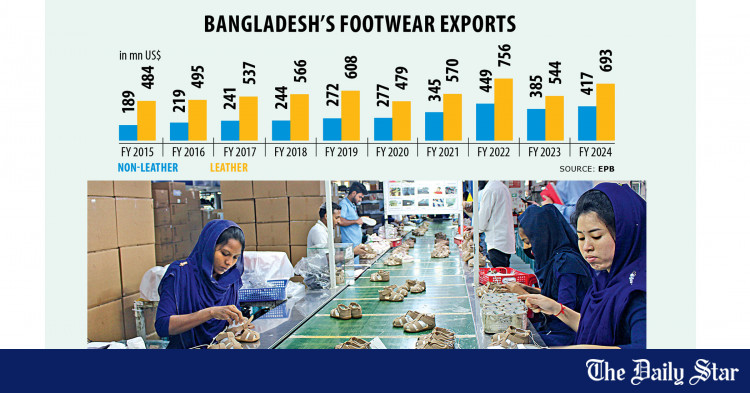
In the decade preceding the end of fiscal year 2023-24, non-leather footwear exports ballooned 120 percent, jumping from $189 million to $416 million.

Such robust growth has continued into the current fiscal year, according to the Export Promotion Bureau (EPB).

In the first five months of FY25, non-leather footwear exports grew 41 percent year-on-year to $217.81 million, EPB data shows.

Exporters anticipate that the sector is poised to enter the half-billion-dollar club by the end of this fiscal year, joining leather footwear, jute and jute goods, home textiles and agricultural products.

"Western buyers are turning away from global footwear giant China to diversify their sourcing basket and avert looming large tariffs on Beijing from the White House," Riad Mahmud, managing director of Shoeniverse Footwear, said as he outlined reasons for the segment's growth.

Mahmud's footwear factory in Mymensingh, which employs around 1,700 people, supplies products to global brands such as Inditex, Aldi, Matalan and RedTape.

Although Bangladesh has long been trying to diversify its export basket, readymade garments still account for over 80 percent of total exports.

Mahmud said global brands are well aware of Bangladesh's advantages, such as competitive labour pricing, and its strong track record in apparel products, which encourages them to place footwear orders.

"Bangladeshi manufacturers can offer competitive prices for synthetic shoes compared to Vietnam due to lower labour costs. This has attracted globally renowned brands and new buyers," he added.

He said big brands had booked Shoeniverse's factory until March next year and buyers are now approaching him for future slots due to the possibility of the US imposing higher tariffs on Chinese products.

According to a market assessment by the Bangladesh Investment Development Authority (Bida), the rise in non-leather shipments is a result of increased work orders from well-known global brands like H&M, Puma, Decathlon, FILA and Kappa.

The main export destinations for these products are Spain, France, the Netherlands, South Korea, India, Italy and Germany.

BETTER THAN LEATHER

EPB data shows that Bangladesh's non-leather footwear exports have grown at an average annual rate of 23 percent in the past 10 years while the leather footwear industry has seen average growth of only 6 percent.

Leather footwear exports grew to just over $544 million in FY24 from $483.81 million in FY15.

However, despite the segment's enormous potential, synthetic shoe exporters receive a cash incentive of only 4 percent, Mahmud said, adding that the leather footwear sector was afforded 15 percent.

Though dominated by small-scale factories, the synthetic footwear segment is rapidly growing due to the relatively low investment required to set up an export-oriented production unit.

"It doesn't matter who enters the Oval Office after Trump since Bangladeshi manufacturers of synthetic footwear are well-positioned to capitalise on any tariffs on China in the meanwhile," Mahmud said.

SYNTHETIC FOOTWEAR THE FUTURE OF EXPORT

Jakaria Shahid, managing director of Edison Footwear Limited, believes the synthetic footwear industry will hold the key to export diversification in the future due to its rapid growth.

However, he added that top global brands like Nike and Adidas have not ventured into Bangladesh because manufacturers fail to maintain lead times.

Mohammad Shahadat Ullah, executive director of Maf Shoes, which exports to France and Germany, said, "Our exports have increased compared to last year as buyers are placing more orders."

Maf Shoes, a sister concern of TK Group, has a daily production capacity of over 50,000 pairs of shoes.

Kamruzzaman Kamal, marketing director of industrial conglomerate PRAN-RFL Group, said RFL began exporting non-leather footwear products in 2021. Currently, RFL footwear products are shipped to 37 countries.

"Given the huge global demand and potential for rapid growth, this sector can quickly emerge as a major export earner," he added.

BOTTLENECKS NEED TO BE REMOVED

Nasir Khan, chairman and managing director of Jennys Shoes, said Chinese companies are now lining up to invest in Bangladesh to avoid high tariffs in the US market.

"However, we are confused about our ability to seize this business opportunity due to the non-cooperation of customs officials," Khan alleged.

He said local manufacturers must now spend at least three and a half months to negotiate and secure an export order.

Khan claimed that despite the bright future of both leather and non-leather footwear, exports have been limited to $1 billion over the past two decades due to the non-cooperation of customs officials.

"The customs authorities receive, at best, Tk 50 crore in import duty from leather product manufacturers annually. Manufacturers must bring raw materials into bonded warehouses," he said.

But, if the National Board of Revenue (NBR) reduces the duty to a minimum and allows the import of raw materials without the bonded warehouse condition, government revenue could increase manifold, he added.

MA Razzaque, chairman of Research and Policy Integration for Development (RAPID), said local leather footwear exports are struggling to grow due to the non-compliance of the tannery estate in Savar.

In contrast, he said, the synthetic footwear industry does not have such compliance requirements, leading to increased exports.

According to Maximize Market Research, a global market research and consultancy firm, the global athletic footwear market was valued at $68.26 billion in 2023.

The market is projected to grow at a compound annual growth rate of 7.11 percent from 2024 to 2030.​
 

Bangladesh to join 19th Cairo Int’l Leather and Shoes Fair starting Thursday
UNB
Published :
Jan 23, 2025 01:00
Updated :
Jan 23, 2025 01:00

1737616350877.png

.
The three-day 19th Cairo Int’l Leather and Shoes Fair 2025 will begin in Cairo, Egypt on Thursday.

The event will take place from January 23-25, 2025 at Cairo International Convention Center, Egypt where Bangladesh will be represented at Pavilion A52, said a press release issued on Wednesday.

Leading Bangladeshi leather, footwear and leather goods companies such A.S Leather, Loretta Leather, Al Madina, Gardenia Footwear and Nobabee Footware will be participating in the premier international leather and accessories exhibition.

This Meet Bangladesh Sourcing Show (MBS) is introduced by Export Competitiveness for Jobs (EC4J) Project under the ministry of commerce to showcase the eminent leather, footwear (leather and non-leather) and leather goods sector of Bangladesh.

The primary objective of the EC4J project is to strengthen export market linkages for potential leather and footwear sectors by showcasing Bangladesh as a credible sourcing destination.

Bangladesh is a lucrative destination for the global buyer community having competitive workforce boosting exports, having duty-free market access to developed countries, being an established sourcing destination and by having availability of linkage industries.​
 
Do you research anything before passing wild comments? Stunting is higher in India compared to Bangladesh (especially high in Northern India BIMARU states (UP, Bihar, MP, Haryana etc.).


1737744190034.png


1737744277007.png


Last edited:
but @Bilal9 .. your Saif guy is a total cvnt

You guys both fly off the handle too much. I deleted both of your comments with foul language.

There is no difference in genetics. All differences are "manufactured" by people who want to rule you.

Hindu Muslim, isn't written on your collective foreheads. Brothers from another mother.

Same type of desis, same mentality. Now - can we all be nice and argue with respect?
 
Last edited:

Members Online

Latest Posts

Latest Posts