[🇧🇩] July uprising

[🇧🇩] July uprising
75
2K
More threads by Saif

G Bangladesh Defense

Yunus urges all to resist dictatorship resurgence
Bangladesh Sangbad Sangstha . Dhaka 01 July, 2025, 17:49

Chief adviser Professor Muhammad Yunus inaugurates a month-long programme on Tuesday to commemorating the July Uprising.

Chief adviser Professor Muhammad Yunus on Tuesday urged people to resist any resurgence of dictatorship in the country, emphasising that history testified that when the people wake up, no force can resist them.

He also urged the people to observe the July Uprising every year to resist re-emergence of autocracy.

‘We will observe this [July Uprising] every year so that we do not have to wait 16 years for another uprising again. We will do this every year so that we can destroy it immediately if there is any sign of dictatorship,’ Yunus said while inaugurating a month-long programme at his office in Dhaka’s Tejgaon, commemorating the July Uprising.

The chief adviser said that a year ago, in the July, the movement that the students started gave the people a taste of freedom by creating an unprecedented mass uprising. The July was an unforgettable call, an awakening of the people in the struggle to restore democracy in the country.

Professor Yunus said that the essence of that movement was - ‘Build a new Bangladesh by eliminating fascism, return the state to the hands of the people’.Bangladesh-themed souvenirs

‘Today, we have taken up the programme to commemorate the July Uprising. This is not just a matter of emotion, it is not a matter of expressing anger,’ he said.

The immediate target of the mass uprising was fulfilled but there was a great dream behind it – to reconstruct a new state system and build a new Bangladesh, he opined.

In his speech, Yunus remembered with deep respect all those who took to the streets and held the flag of democracy high, and became the symbols of courage, sacrifice and determination during the uprising.

He said that the month-long programme beginning Tuesday was not just a remembrance, but a new oath. ‘We want the unity that was created among people of all classes, professions and ages of this country in July last year to be consolidated again this July.’

The chief adviser said that the main goal of the programme was to make the people aware of their democratic rights, demand political accountability, and not to miss the opportunity for reforms obtained at the cost of blood.Bangladesh-themed souvenirs

‘The path ahead of us is very difficult, but there is also great potential. History testifies that when the people wake up, no force can resist them,’ Yunus said.

With that belief, the chief adviser called upon all to make the July, month of mass awakening and unity.

Through the programme, throughout the month of July-August, he said that they would revive every day of the last year for which the young students, commoners, rickshaw pullers, and workers were martyred and injured, and they would take a new oath to implement that goal.

Yunus inaugurated the month-long programme to commemorate the July Uprising and wished the programme a success. On the occasion, he unveiled the QR code of the programme. He also handed over scholarship cheques to three National University students.

Cultural affairs adviser Mostofa Sarwar Farooki and education adviser CR Abrar also spoke.​
 

Govt moves to recognise Rohingya youth’s role in July uprising

FE ONLINE DESK
Published :
Jul 02, 2025 19:28
Updated :
Jul 02, 2025 19:28

The government is moving to formally recognise Rohingya youth Noor Mostafa for his role in the July 2024 uprising.

Information Adviser Mahfuj Alam revealed the move in a Facebook post on Wednesday, which was later shared by the Chief Adviser’s Press Secretary, Shafiqul Alam.

According to the post, Mahfuj Alam presented the recognition proposal at a cabinet meeting held on 22 June.

The Department of Mass Uprising is currently processing the recognition, and an official notification is expected soon.

In his post, Mahfuj Alam concluded: “July belongs to everyone.”​
 

The July that rocked Bangladesh
July 2, 2024: Protesters brave rain, warning

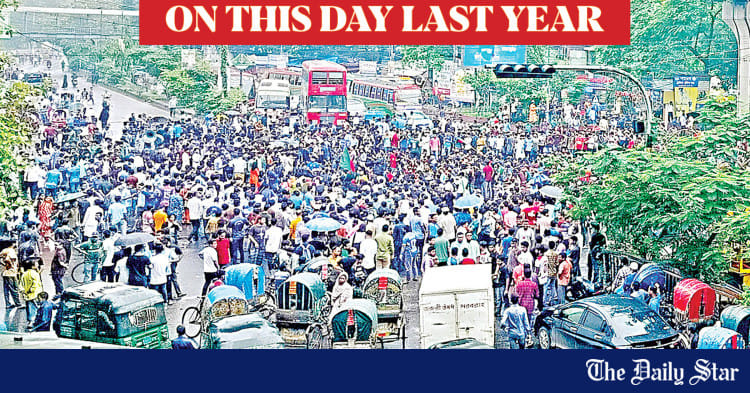
Students block the Shahbagh intersection on July 2, 2024, demanding the reinstatement of the 2018 government circular that abolished the quota system in civil service recruitment and the introduction of a merit-based system. FILE PHOTO
Defying rain, warnings, and exhaustion, the anti-quota protests gained momentum for the second consecutive day as hundreds of students and job seekers poured into the streets of Dhaka on July 2. Carrying the energy of the previous day's mobilisation, demonstrators continued their demand to reinstate the 2018 circular that had abolished quotas in government jobs -- a circular recently nullified by a High Court verdict.

The day's protests were part of a three-day nationwide programme declared a day earlier by the Boishomybirodhi Chhatra Andolon (Students Against Discrimination), which was spearheading the agitation. The programme began around 2:45pm with a large rally from the Dhaka University Library premises. The procession moved through Nilkhet, Science Laboratory, and Bata Signal, finally arriving at Shahbagh intersection.

There, demonstrators occupied the streets, blocking traffic and chanting slogans such as "Quota na medha, medha medha" (Merit, not quota) and "Boishomyer biruddhe, direct action" (Direct action against discrimination). By the time they reached Shahbagh, a heavy police presence had already taken position. Students, undeterred, shouted "Bhua bhua" (fake, fake) at the law enforcement agency. No clash occurred, and the police eventually stepped aside.

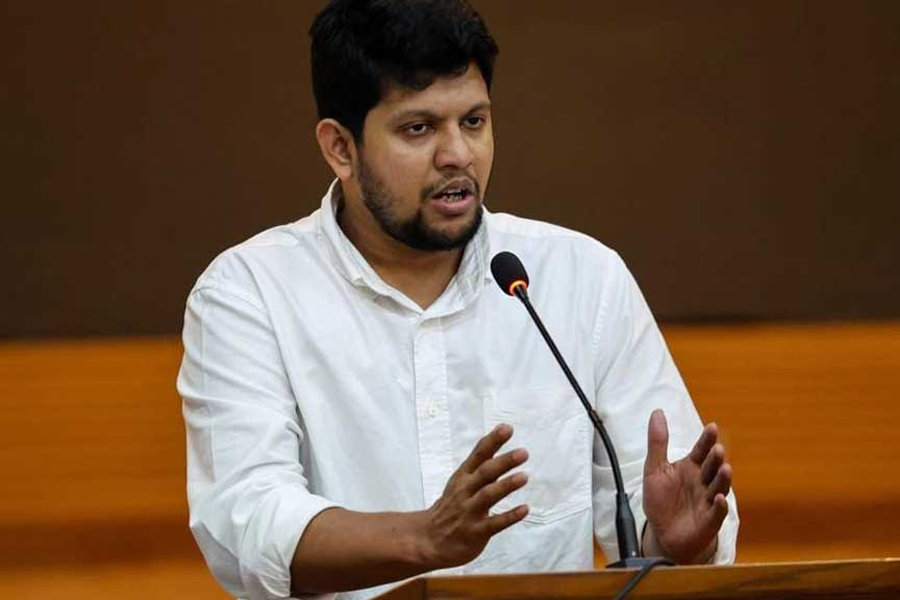
"This movement is not just about students or job seekers -- it's about the kind of state we want to build," said Nahid Islam, coordinator of the movement, addressing the gathering. "The spirit of the Liberation War is not a hereditary privilege; it is a national ideal. We, the youth, are upholding that spirit by standing against discrimination."

He announced that the protests would continue the next day with a sit-in at 2:30pm in front of the Dhaka University library and urged students across all universities and colleges in the country to join the movement simultaneously under a united banner.

For nearly an hour, the protesters held their ground at Shahbagh before lifting the blockade around 4:45 pm. From there, they marched towards the vice chancellor's residence of Dhaka University, where they demanded the reopening of the university library, which had remained shut for two days. Teachers, officials, and staffers of public universities have been abstaining from work since July 1 in protest against the government's Universal Pension Scheme, prolonging the stalemate in the activities of higher educational institutions across the country.

While Dhaka University became the epicentre of the day's protests, similar demonstrations unfolded across other campuses as well. At Jahangirnagar University, a group of students blocked the Dhaka-Aricha highway around 3:00pm, demanding the cancellation of the reinstated quota system along with three other demands. The blockade lasted for about 20 minutes and resulted in a two-kilometre traffic snarl in both directions. Earlier, the students had held a protest rally from the base of the Shangshaptak sculpture near the university's central library.

The protesters had also announced plans to enforce a two-hour highway blockade again on July 3, from 3:00pm to 5:00pm—further intensifying the spread of the movement beyond the capital.

Students from Barishal University, Jagannath University, Chittagong University, and Islamic University in Kushtia also organised processions and rallies, occupying campus roads and entry points.

Earlier in the day, around 10:30am, members of the pro-government organisation Bangladesh Muktijoddha Sontan Sangsad gathered in front of the Raju Sculpture at Dhaka University, opposing the anti-quota protests and advocating for the preservation of the 30 percent quota for children of freedom fighters.

By its second day, the anti-quota protest showed no signs of slowing down. With swelling participation, coordinated action, and a powerful moral claim, the movement was rapidly transforming into a nationwide youth uprising -- challenging not just a single policy but the deeply rooted structures of privilege and inequality.​
 

First phase of July Uprising was ‘meticulously designed’, says Advisor Mahfuj

bdnews24.com
Published :
Jul 05, 2025 00:06
Updated :
Jul 05, 2025 00:07

1751671618836.webp


Information Advisor Mahfuj Alam has described the initial phase of the July Uprising as a “meticulous design”, crediting it for preparing the ground that ultimately led to the fall of the Awami League government.

He has also firmly denied that the Uprising had any connection to “mob violence” across the country.

In a pair of Facebook posts over the past 24 hours, Mahfuj has re-entered the political conversation after remaining largely silent since facing backlash two months ago for urging Jamaat-e-Islami to apologise for its alleged role in the 1971 Liberation War.

His new posts, one on the design of the uprising and another on “mob violence”, have each drawn several hundreds shares, though the comment sections remain locked.

Mahfuj has drawn a sharp line between the planned political groundwork and the mass uprising that followed.

He explained the July Uprising unfolded in two phases: between Jun 5 and Jul 18, a foundation was built for leadership and mobilisation; from Jul 19 to Aug 5, students and citizens across the country took charge of the movement.

The first phase, he said, was “strategically” crafted, while the second phase was shaped by the sacrifice and participation of revolutionary students.

1751671643065.webp


‘WHAT’S THE ISSUE WITH METICULOUS DESIGN?’

In a speech delivered in the United States last year, Chief Advisor Muhammad Yunus described the July quota reform protests as “meticulously designed” -- a remark that has since been repeatedly used by fugitive leaders of the now-banned Awami League as evidence of conspiracy behind the Uprising that led to the end of the party’s 15-year rule.

In his post, Mahfuj defended the idea of strategic planning, arguing that many of Bangladesh’s most defining struggles were “not spontaneous but carefully designed”.

He pointed to the Agartala Conspiracy, the 1969 mass uprising, and the March 1971 non-cooperation movement as precedents.

“What’s wrong if the 2024 Uprising was also meticulously designed?” he asked. “No revolution in the world has ever succeeded without a plan. People need strategic guidance and political clarity until the conditions are ripe.

“Once that’s achieved, they move on their own -- but that doesn’t mean the design was unnecessary.”

The advisor argued that a well-planned people’s movement should be “a source of pride”.

“If Serajul Alam Khan, Tajuddin Ahmad, Siraj Sikder, Bhashani -- even Sheikh Mujib himself -- didn’t feel guilty for being part of strategic efforts to defeat Pakistan, and we honour them despite their flaws, why shouldn’t this generation be proud of removing Hasina through a well-planned uprising?”

Mahfuj also rejected claims of foreign involvement.

Apart from a statement by the UN before the one-point declaration on Aug 3, 2024, he said there was “not a shred” of influence or coordination from foreign powers or the military.

He added, “If Sheikh Mujib and others deserve respect for coordinating with India in Agartala to launch the war of independence -- and they do -- then why are the Uprising’s leaders and participants being criticised when no such foreign or third-party involvement existed?”

“Look at the series of events from Maulana Bhasani’s 1968 gherao movement to the 1969 uprising, or March 1971--you will find examples of both meticulous design and spontaneous rebellion,” Mahfuj wrote.

Attempts to contact Mahfuj were unsuccessful.

1751671678864.webp


‘REVOLUTIONARY STUDENTS AREN’T A MOB’

Turning to the wave of violence that followed the Uprising, Mahfuj drew a sharp contrast.

“A mob,” he wrote, “is an opportunistic group driven by vengeance, with no political vision or purpose.”

By contrast, he said the July student protesters had a defined mission, deep respect for democracy and human rights, and a historic role in shaping the country’s future.

He described mob violence as “a form of social fascism”, which, he argued, was a direct product of 16 years of “political fascism” under Sheikh Hasina.

“Unless we understand this connection,” he said, “we won’t be able to confront ‘mob mentality’ and ‘social fascism’.”

Labelling groups as “Islamofascists” would not solve the issue either, he warned.

Instead, he pointed to July’s ability to open space for dialogue across ideological lines and urged that this momentum be used to tackle the real roots of social fascism: the collapse of democracy and the rule of law under Hasina.

He complained that even though July's student protesters were not part of any violence, they have been unfairly blamed for later incidents of “mob violence”.

“If a mob had emerged after July, we wouldn’t have seen so much civility or this flood of apologetic narratives,” Mahfuj wrote.

Citing past examples of mob violence, Mahfuj listed the attacks on the Bihari community, on anti-Mujib young freedom fighters, and on religious minorities -- often with alleged backing from major political parties.

“If you stretch the definition of a ‘mob’,” he wrote, “you’d have to include the ‘people’s court’, the ‘people’s stage’ of ’96, Oct 28, and even Shahbagh -- all examples of ‘mob justice’ and ‘mob violence’.”

As an advisor, he said the state’s duty was to uphold the rule of law. That was why he had spoken out several times about the dangers of mob action -- from attacks on shrines to incidents at book fairs.

He criticised political leaders who are now trying to paint the July Uprising as “a mob movement”.

“It’s alarming that Mujibist leftists and the Awami League’s cultural thugs are now portraying the July revolution as mob violence and linking it to the law and order situation that followed.”

“If this was really mob rule,” he added, “the student revolutionaries wouldn’t have kept the country safe for one and a half months without police or Ansar.”

He brushed off the account of saving Obaidul Quader during the uprising as a “scripted fabrication”.

“The scriptwriters assumed it would be believable because the revolutionary students were not vengeful.”

He urged supporters to remain lawful but also prepare for political resistance.

“If laws are violated, or if communal or political violence occurs, take legal action. The student masses of the July uprising must act responsibly in upholding the rule of law.

“But in facing Mujibism and imperialism, you must also build resistance with your utmost effort,” he added.​
 

A year since the mass uprising: Not wanting what we get
When we look at the bigger picture, one year is nothing in the life of a nation. But we’re not starting from zero. Elections have been held in this country since 1919. Several political parties are over a hundred years old. Have we learned anything from that history? Or do we start all over again every five years?

Mohiuddin Ahmad
Updated: 04 Jul 2025, 17: 37

1751676664955.webp


When we look at politics in Bangladesh, Rabindranath’s poem 'Morichika' (Mirage) comes to mind. In the final stanza, he writes: "That which I cling to, in that I no longer/Find any music at all./What I seek, I seek in error/What I get, I do not want" Are we chasing a mirage?

We first encountered the concept of a mirage in childhood textbooks: a weary traveler walking through an endless desert sees water shimmering in the distance. But it’s only sunlight reflecting off scorching sand, an illusion that ultimately leads to collapse and death. We seem to be running after just such a mirage, forever out of reach.

Politicians have taught us that if we listen to them and follow their path, we’ll reach the shores of happiness. And so we walk, roam and run, but the road never ends. Happiness never arrives.

Leaders present one manifesto after another, with such attractive names. They promise that we’ll reach the pastures of democracy, that socialism has arrived, a land without inequality. They tell us the country’s sovereignty is under threat. If we vote for them, it will be protected. Then, they say, all our needs will be fulfilled.

And we do have so many wants. Rabindranath gave voice to them in such beautiful language: "We want food, we want life, we want light, we want free air/We want strength, we want health, a life full of joy and vitality."

Two.

There was bloodshed and war. The country became independent, but the people did not. Since birth, I’ve seen a "wounded homeland". There have been movements, regime changes, broken dreams, then all over again -- movements, regime changes, shattered dreams. It’s a vicious cycle. We return to where we started. The circle never breaks.

Patriotism is a sentiment. The desire for development goes hand in hand with it. Without development, what good is a country? A few well-established syndicates of seasoned players toy with this sentiment like a game of "kabaddi". They grow stout and strong. They turn from riding ramshackle tempos for flashy BMWs. One syndicate opposes another, meting out promises of hope. We forget what happened five or ten years ago. Once again, we run after the mirage.

Why has Golden Bengal become a cremation ground? That question had once taken our nationalist movement to the peak. We won independence. Our political guardians gifted us the worst famine of the century. While rice rotted in warehouses, people died of hunger on the streets. Since then, we’ve witnessed one ruler after the other, sometimes in civilian garb and sometimes in military uniforms.

The aspirations and sentiments of the people have been turned into political capital, leading to one regime change after another: 1971, 1975, 1990, 1996 and most recently, 2024. We witnessed the longest July in history. It felt like the poem: "We pledge our lives and deaths/Comrades, the final battle begins today/Come, let us unite." A massive boulder has rolled away, but then what?

Three.

Was 36 July an uprising, a rebellion, a revolution or a riot? Orators and writers are still debating over this. We cannot even agree on even a single word. Some say we’ve gained a "second independence." Everyone is now so free, they can do whatever they want. “Grab so-and-so, beat up so-and-so”-- that’s the daily routine now. Apparently, this is the nature of revolution: it obeys no rules. One is reminded of that line from Bhupen Hazarika’s song: “Old rules shatter in the storm of chaos.” We’ve been caught in that storm.

Except for a handful of beneficiaries and dynasty-worshippers, everyone wanted Hasina to step down. The movement wasn’t built with elaborate planning, blueprints or lofty statements of missions and visions. So now, after Hasina has fled, the question arises: which path will we take?
The country remains where it was. Authorities are floundering over the wording of the constitution. Government offices fail to provide services. The mafia still reigns over public transport. Boys from the villages are building drones and airplanes, while our top engineers are crafting rickshaws in backstreet workshops. What we really needed was a few thousand modern buses. What kind of backward mentality afflicts a nation that ends up like this?

Now we’re hearing talk of the "Three Zeros." Jokes are going around - zero growth, zero employment, zero law and order. What do we need first? Europe, after scaling the heights of industrialisation and growth, is now pursuing human development. We haven’t even managed a proper take-off. Are we going to hitch the cart before the horse? Can’t we understand what our priorities should be? The crop that’s most widely flourished in this country right now is "despair".

We haven’t yet moved beyond the rhetoric of politics. Everyone is stuck in their same old rhetoric. Some talk of 31 points, others of a new settlement, still others of politics rooted in accountability and empathy. Beautiful phrases!

When we look at the bigger picture, one year is nothing in the life of a nation. But we’re not starting from zero. Elections have been held in this country since 1919. Several political parties are over a hundred years old. Have we learned anything from that history? Or do we start all over again every five years?

The most talked-about word in the country now is "reform". But is reform only for the constitution? What are our real priorities? Can people survive on the constitution alone? To give people peace and relief, four services are most essential: education, healthcare, public transport, and public safety. We score poorly in all four. Do we really need to wait until the next election to start working on these? Can’t we begin now? We see no tangible progress.

Four.

Some are happy as long as the word "socialism" stays in the constitution. It must not be removed. Yet, some also want a “Caliphate.” Let the politicians keep wrestling with these words. They, after all, don’t have to worry about food or shelter.

If people are to survive, many things must be arranged for them. What’s most needed right now is the restoration of law and order and the creation of employment. Who is thinking seriously about these two issues? What good will it do to roar empty political slogans? The conventional political model won’t work in this country anymore.

In the July movement, we saw men and women, children and the elderly, all stepping out into the streets, risking their lives. These millions weren’t protesting about BCS exams or quotas. They wanted freedom from a suffocating and cruel system of governance. The quota reform movement was led by students. But the spontaneous participation of the people transformed it into a one-point movement. Except for a handful of beneficiaries and dynasty-worshippers, everyone wanted Hasina to step down. The movement wasn’t built with elaborate planning, blueprints or lofty statements of missions and visions. So now, after Hasina has fled, the question arises: which path will we take?

There’s no way forward without a social contract involving everyone. If anyone thinks they understand everything while others don’t, and that it’s their duty to guide everyone, they are mistaken. Our ability and willingness to move forward together will determine whether we can emerge from this stalemate.

Bangladesh is still burning. There’s no reason to think that 36 July brought history to a standstill. Nothing has been resolved yet.

* Mohiuddin Ahmad is a writer and researcher.​
 

The July that rocked Bangladesh
July 5, 2024: Nationwide protests persist despite holiday

1751678685693.webp

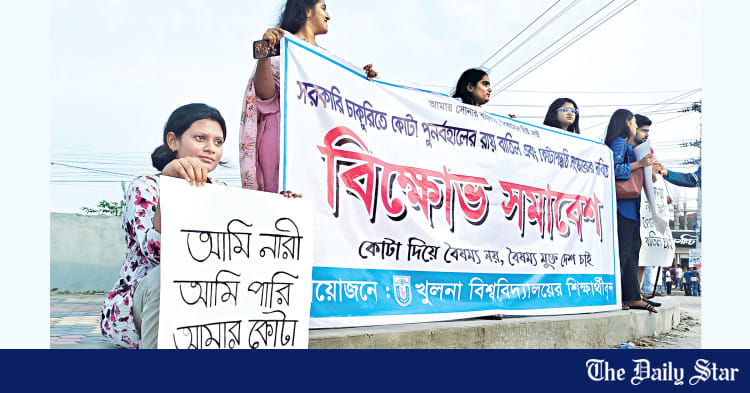
A group of students from Khulna University formed a human chain in the city on July 5, 2024, protesting the reinstatement of quota system in government recruitment. FILE PHOTO

Even on a holiday, the quota reform protests show no sign of slowing. Students across Bangladesh take to the streets, block roads, form human chains, and voice their rejection of the reinstated quota system in government jobs. What began as student anger has now grown into a nationwide movement, with teachers, political groups, and ordinary citizens extending their support.

In Chattogram, students of Chittagong University gather at Shaheed Minar and later block the Sholoshohor road from 4:00pm, halting traffic for nearly an hour and a half. They chant slogans demanding an end to discrimination and call for the complete abolition of the quota system.

In Dinajpur, braving rain, students of Hajee Mohammad Danesh Science and Technology University (HSTU) hold their protest in front of the campus gate. They raise slogans such as "Merit, not quota!" and "No place for discrimination in Golden Bengal," standing firm in their demand for fair recruitment.

In Tangail, students from Mawlana Bhashani Science and Technology University form a human chain at the campus entrance, joining the growing national chorus for justice and equality.

Protests also erupt at Jahangirnagar University, where students block the Dhaka-Aricha highway for about 20 minutes in the afternoon. Their blockade creates a two-kilometre-long traffic jam as they press their four-point demand, including the immediate cancellation of the quota system.

In Khulna, students of Khulna University stage demonstrations and block roads in the Shiromoni area, bringing traffic to a halt and amplifying their demands.

In Gopalganj, students from Bangabandhu Sheikh Mujibur Rahman Science and Technology University hold protests for the third consecutive day, demonstrating the movement's resilience and growing geographical spread.

Teachers, too, join the tide of protests. At Dhaka University, many teachers express solidarity with the anti-quota movement. The Dhaka University "white panel" -- a platform of pro-BNP and Jamaat teachers -- extends formal support to the students.

The movement of teachers and staff against the proposed Universal Pension Scheme also continues across 39 public universities nationwide.

Meanwhile, progressive political alliance Gonotontro Moncho holds a rally in front of the Jatiya Press Club in Dhaka, where its leaders accuse the government of trying to crush these movements through repression. Jonayed Saki, chief coordinator of Gonosonghoti Andolon, declares, "The government has entered a death game. It is killing people, abducting dissenters, and destroying the country, yet it refuses to relinquish power."

Saki affirms that the student protests are genuine and not politically manipulated. "We support the students' movement. We support the teachers' movement. We stand with every movement of the people of this country," he says. He warns that the government is deploying goon squads and helmet gangs to suppress protests on campuses, but insists that these tactics cannot defeat the collective uprising.

As the day ends, it is clear that the July uprising is spreading its roots deeper into the country's political landscape -- transforming into a broader movement for democracy, accountability, and fairness.​
 

Constable in Kushtia suspended for making ‘derogatory remarks’ about July Uprising

bdnews24.com
Published :
Jul 05, 2025 20:43
Updated :
Jul 05, 2025 20:43

1751757070213.webp


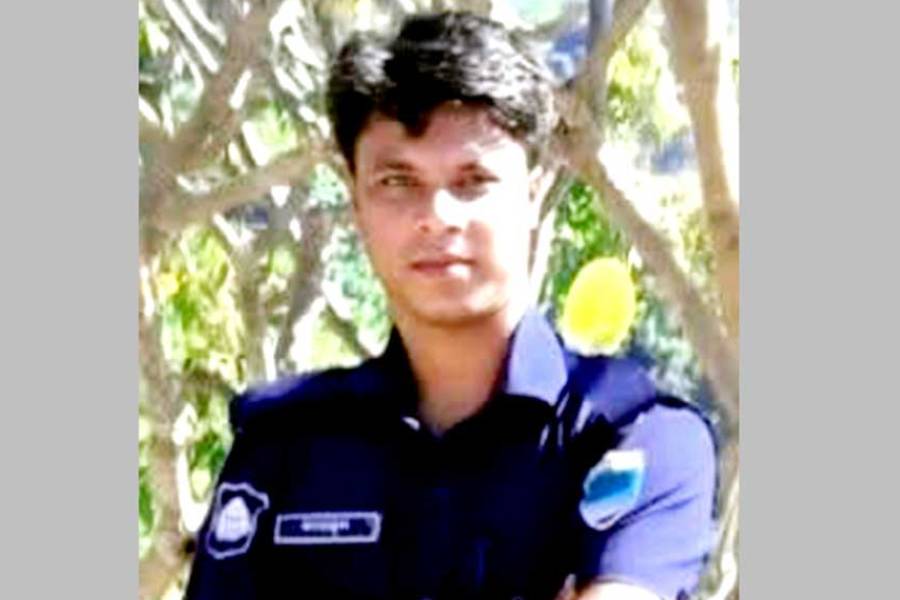
A police constable in Kushtia has been suspended for making “derogatory remarks” about the July Uprising on social media.

District Police Superintendent Mizanur Rahman said on Saturday, “As the investigation has found primary evidence, it has been recommended to suspend and dismiss Constable Farzul Islam Rony.”

On Jul 1, Rony made a Facebook post about the student-led mass uprising that toppled the Awami League government, but deleted it shortly afterwards.

He later claimed his account had been hacked. The post, however, had already drawn widespread criticism.

That night, leaders and activists of the Anti-discrimination Student Movement protested in front of the district superintendent of police’s office on the Kushtia-Ishurdi Highway, demanding Rony’s arrest and dismissal.

On Jul 2, a committee was formed to investigate the incident, comprising Additional Superintendent of Police Sikder Mohammad Hasan Imam, Additional Superintendent of Police (Sadar Circle) Pranab Kumar, and Inspector Debashish Roy.

Anti-discrimination Student Movement’s (Kushtia) Member Secretary Mostafizur Rahman said, “There is no opportunity to belittle the July achieved through the sacrifices of the students and the public against the fascist regime. This step taken against Rony will set an example.”

Rony hails from Shailkupa Upazila of Jhenaidah. He had been working in the Kushtia Traffic Department since Jul 13, 2023. A police official said he is currently in hiding.​
 

How social media became the frontline of the July Uprising

1752112971721.png

Image: LS

The July Movement did not start with a hashtag. It started with rage, grief, and a country cracking under pressure. However, it found its momentum online, mutating into a hybrid of protest and pixels, strategy and storytelling, bloodshed and bandwidth. When bullets hit the streets, stories hit the feeds. Before headlines could make sense of it, Instagram stories, Facebook lives, digital illustrations, and satirical memes did the job. And it was not the newsrooms that led this. It was a decentralised army of students, actors, presenters, illustrators, and people you would never have heard of, until they became the voice you could not ignore.

1752113000407.png

Manzur-al-Matin

A movement that could not be silenced

"Social media acted as a replacement for mainstream media," said Manzur-al-Matin, a lawyer, television host, and one of the familiar faces during the July mass uprising.

"Excluding a few newspapers, television in particular, was not showing anything. News of people dying was not coming out. There was a kind of media silencing… So, people became dependent on social media. It played a role both in mobilising and informing."

Matin recalled receiving tactical instructions via social media — how to treat tear gas wounds, how to regroup when scattered — "a tool for mass mobilisation," he called it. What made this different was that it did not rely on polished journalism. It relied on urgency, on participation, on people stepping up, logging in, and refusing to scroll past injustice.

Dipti Chowdhury, a TV presenter, also found herself at the centre of this shift. Her televised words, spoken during an internet shutdown, managed to go viral. She became, unwillingly, a symbol.

"That interview wasn't about me," she said. "It was everyone's experience of being silenced. People saw their own frustrations in my words.

"It's very difficult to control social media in a place where every person is like a TV channel. Even when the internet was shut down, VPNs kept the movement alive. People trusted social media more than conventional news."

Matin echoed the same. "We didn't speak up to go viral. We spoke up because staying silent felt like complicity. I tried to speak on TV. But after the 20th or 21st, that door closed. So, we took to the streets."

1752113063203.png

Dipti Chowdhury

Praise, backlash, and the algorithm

Praise came. Then the backlash. Then came the algorithmic silence.

"We saw how some who praised us started abusing us later," Matin added. "But we still spoke up, even when it was no longer popular. Because conscience doesn't follow trends."

Chowdhury experienced this backlash not as a political figure, but as a woman.

"My family's legacy of freedom fighters was questioned. Memes were made about me. My gender became ammunition," she said. "We united in July. But afterwards, we returned to what we know best – isolating people."

Both Chowdhury and Matin agreed: the hardest part was not speaking up during chaos. It was standing firm in the silence that followed.

The mob in the mirror

What came next was even messier: everyone claiming activism. Everyone claiming to speak for "the people." But at what point does advocacy turn into mob rule?

"Most people don't understand what activism truly is," Chowdhury said bluntly. "They're provoking, dividing, claiming moral authority without responsibility. We've confused activism with chaos."

Matin was more philosophical. "Hate spreads faster online. The algorithm rewards outrage. But what we see on social media does not always reflect who we are as a people."

And yet, both admit that digital spaces can no longer be dismissed as fluff. "Social media isn't just entertainment," Chowdhury emphasised. "It's political, it's economic, and it's dangerous when left unchecked."

Trauma, memory, and scrolling past grief

The digital aftermath is murky. The self-censorship that once ruled the internet is now replaced by a chaotic flood of unfiltered rage. But is that freedom – or another kind of trap?

Matin believes self-censorship still exists. "Just in different forms. Those who were once in power used to speak freely. Now, they censor themselves. And those who feel safe now speak recklessly. Social media gives voice to both truth and narcissism," he explains.

Chowdhury agreed but added nuance. "Yes, people post more freely now. But many also post for profit. Likes mean money. Satirical videos have become a business. So, where's the integrity?"

Perhaps, the deepest thread running through both voices is that of mental health. The digital battlefield leaves no one untouched.

"People witnessed real trauma," Matin said. "Violence, death, loss. But did they process it? No. They escaped to social media – only to be retraumatised."

He warns that "reels reduce thinking. Fake happiness makes us feel worse." Negativity spreads faster than truth. If we don't become aware of how these platforms shape us, we'll lose more than we realise.

The fight is not over

July did not end in July. Its aftershocks continue – online and offline. It was a movement not just of protests, but of digital defiance. It exposed both the power and the peril of social media in Bangladesh.

"Every phone became a newsroom," Chowdhury said. "Every person became a media outlet."

And in that chaos, some truths became undeniable: that storytelling is resistance. That silence can be louder than screams. And that even when the cameras are off, the algorithm keeps recording.

So, what's left now?

Maybe it's what Chowdhury suggests: "Social media should no longer be treated as a toy. It's a weapon, a tool, and a responsibility."

Or maybe it's what Matin reminds us: "Praise fades. Backlash fades. What remains is your own conscience. So, speak when you must. But also listen. And never confuse noise with clarity."

Chowdhury elaborates — "I was afraid. I didn't stay at home for days. I received threats saying if a certain party came to power, I'd be raped in the street or killed on sight. But I also received so much love. At one point, I thought — even if I'm jailed or killed, this much love is enough for a life."

As the dust settles, one thing remains clear: social media is no longer just a passive medium in Bangladesh. It is a force that can amplify movements, challenge silences, and reshape public consciousness. How this force is wielded in the future will continue to define the contours of resistance, representation, and responsibility in the digital age.

Photo: Collected​
 

Latest Posts

Back