[🇧🇩] Monitoring Bangladesh's Economy

[🇧🇩] Monitoring Bangladesh's Economy
1K
31K
More threads by Saif

G Bangladesh Defense

Aziz Mohammad Bhai buys 27 lakh new shares of Olympic Industries
He now holds 17 percent or Tk 499 crore worth of shares of the company

Aziz Mohammad Bhai, chairman of Olympic Industries, has completed purchasing 27 lakh new shares of the company at prevailing market price through the Dhaka Stock Exchange (DSE).

With the purchase, he now holds 17 percent shares of the company at the end of June 2023.

The value of the 3.37 crore shares he presently owns stands at Tk 499 crore, according to a posting of Olympic Industries on the DSE website today.

Of the 19.99 crore shares of the company, directors and sponsors now hold 44.66 percent shares, foreign shareholders 23.96 percent, general investors 11.51 percent and institutional investors 19.87 percent as on June 30 of 2023.

The largest biscuit maker in Bangladesh made a profit of Tk 155.6 crore in the 2022-23 fiscal year ending on June 30, up 29 percent year-on-year, according to the company's annual report for 2023.

The share price of Olympic has been experiencing a falling trend. In the last one year, its highest price was Tk 176.8 on April 26 of 2023 and the lowest Tk 141.2 on November 27 same year.

Today, Olympic shares ended the day at Tk 148, down 0.54 percent from the previous day.

The stock investors feel encouraged when an owner purchases shares of a company amid a price falling trend, said Mohammad Emran Hasan, managing director and chief executive officer of Investit Asset Management.

"When a sponsor purchases shares of his/her own company, it means the person has confidence in the company's stocks and it gives confidence to the small investors."

The investors who have available cash should invest ideal money on the stock market during a falling trend, because within a few months the prices will rise again, he said.​
 

Bangladesh govt's debt servicing for foreign loan soars
Interest payment crosses $1 billion mark for the first time

1713826866296.webp


Bangladesh's foreign debt servicing surged by 49 percent, driven by a spiralling interest payment that crossed the $1 billion mark for the first time. This increase is due to the country's rising borrowing from high-interest sources.

In the July-March period of the fiscal year 2023-24, the government paid $1.05 billion in interest, which is 117 percent higher than the $485 million it paid during the same period a year ago. This data was released by the Economic Relations Division (ERD) yesterday.

During the same period, the repayment of the principal amount of foreign loans rose by 22 percent year on year to $1.5 billion.

Overall, debt servicing soared by 49 percent to $2.57 billion in the July-March period of FY24, compared to the same period a year ago.

The pressure on loan servicing is rising with the government's increased borrowing to finance large infrastructure projects. These projects include the Dhaka Metro Rail, Matarbari Coal Power Plant, and Rooppur Nuclear Power Plant, funded by bilateral and multilateral sources.

As of December 2023, the external debt of the Bangladesh government stood at $79.6 billion. This figure was approximately over 13.7 percent of the nation's Gross Domestic Product in the fiscal year 2022-23.

In recent years, the government has borrowed a good amount of money from multilateral agencies. This was done to help the economy navigate the crisis caused by the coronavirus pandemic and the global economic turmoil following the Russia-Ukraine war.

Officials have stated that loans taken from foreign sources now have a shorter grace period. Additionally, interest rates are now tied to the global reference rate -- the Secured Overnight Financing Rate (SOFR). This rate replaced the London Interbank Offered Rate (Libor) last year.

In recent periods, the SOFR rate has seen an increase.

Official data revealed that Bangladesh paid $935 million in interest payments in FY23, nearly double the $491 million paid a year ago.

The latest data from the Economic Relations Division (ERD) showed that the overall commitment from foreign lenders grew by 135 percent year on year to $7.2 billion in the July-March period of FY24. However, disbursement only increased by 5 percent year on year to $5.6 billion in the nine months leading up to the end of March 24.​
 

3rd Loan Tranche: IMF team to focus on four key areas
Forex reserves, inflation, banking sector, revenue reforms to come up for talks

1713999368747.webp


During its visit to Dhaka, the International Monetary Fund's review mission will focus on Bangladesh's foreign exchange reserves, inflation rate, banking sector, and revenue reforms.

The 10-member IMF mission is scheduled to reach Dhaka today, and from tomorrow, it will begin to hold meetings with the finance division, Bangladesh Bank, the National Board of Revenue, and other government bodies.

The mission will stay in Dhaka until May 8. The IMF has already sent more than 100 questions to the government officials.

Since the IMF approved the $4.7 billion loan for Bangladesh in January last year, the multilateral lender has so far released $1.16 billion in two tranches.

Bangladesh sought the loan amid a crisis of forex reserves.

However, the reserves have not improved since the loan programme commenced. The country's gross forex reserves have been around $20 billion in recent months, as per an IMF calculation.

One of IMF's major conditions for the loan is that Bangladesh maintain a certain net international reserves (NIR). Bangladesh failed to meet it in the first review, and is going to fail this time again.

Besides, inflation has been over nine percent since March last year.

During a press briefing on the sidelines of the Spring Meetings of the World Bank Group and IMF in Washington, DC on April 18, IMF's Asia and Pacific Director Krishna Srinivasan said Bangladesh's reserve position has not improved much.

Referring to Bangladesh's elections, he said, when elections take place, there's always some uncertainty about prospects. This affected part of the financial account, he added.

"But also, I think it's important for Bangladesh to transition to a more flexible exchange rate regime. That will be important to build external resilience and build buffers and build reserves. So, I think that is the area where engagement and dialogue continues in terms of allowing the exchange rate to be more flexible so that reserves can be built up, so that, in a sense, will be a key priority for the country going forward," he said.

For macroeconomic stability, the visiting IMF mission will discuss matters related to fuel, power and energy subsidies, public debt, upcoming budget, and performance of the state-owned enterprises.

For over a decade, Bangladesh's revenue collection has been around eight to nine percent of the GDP. The IMF loan programme has several reform proposals for the revenue sector.

Also, several reform proposals for the banking sector and their progress including implementation of the bank company act will be discussed during the IMF mission's visit.​
 

IMF suggests raising power, gas and fertiliser prices

1714086233585.webp


The International Monetary Fund yesterday recommended reducing government subsidies by hiking prices of power, gas and fertiliser, and spending the saved money on society safety net programmes.

The visiting IMF mission, during a meeting with finance ministry officials, also recommended the inclusion of more poor people in the programmes and better monthly allowances for them.

The mission, led by Chris Papageorgiou, held a series of meetings with the officials of the Finance Division and the Financial Institutions Division yesterday. It also discussed the government's macroeconomic framework, implementation of laws related to the banking sector and financial institutions, classified loans, and Bangladesh Bank's move to merge banks.

Finance ministry officials said the government has decided to gradually hike the prices of power and gas over the next three years to the level of their production costs.

The measures would be implemented so that the government does not have to subsidise the sectors, said an official. The official, however, said the government has no plans now to increase fertiliser prices.

The IMF mission during a meeting with the Finance Division was told that the government would continue subsidising the agriculture sector.

After entering into the IMF's $4.7 billion loan programme in January last year, the government hiked the prices of electricity and gas several times. It had increased the price of urea fertiliser by 5 percent in August 2022, after 11 years.

Since the 2022-23 fiscal year, the government's subsidy on electricity, gas and fertiliser nearly doubled.

In the current fiscal year, subsidy allocation is Tk 84,542 crore and it could be about the same next year, Finance Division officials told the IMF mission.

The IMF wanted to know whether the government had any plans to increase allowance for the poor under social safety net programmes and what the government was planning next regarding the programmes.

Officials told the mission that they were going to increase the number of beneficiaries by around five lakh but there were no plans to improve the allowances due to fund constraints.

About 58 lakh elderly people are getting Tk 600 per month in the current fiscal year. Their number will be increased by two lakh in the next fiscal year.

All eligible senior citizens are getting the benefit in 262 upazilas. All eligible individuals in the remaining 233 upazilas will be brought under the scheme gradually.

The officials said about 2.5 percent of the GDP would be allocated for society safety net programmes next fiscal year.

The finance ministry issued two circulars to bring all safety net programmes under a new structure to reduce waste, misuse, and corruption.

The IMF mission, during its meeting with the Financial Institutions Division officials, said it supported the policy of merging banks and laid importance on following international best practices while implementing the move. It said India took a similar move and it yielded good results.

The IMF mission recommended reducing state-owned banks' classified loans to 10 percent from over 20 percent and wanted to know what action the government was taking against wilful loan defaulters, meeting sources said.

The officials told the mission that commercial banks would send lists of wilful defaulters to the central bank and the central bank would take action as per the bank company law.

During another meeting, the Finance Division presented the country's macroeconomic projection before the IMF mission, sources said.

The officials told the IMF mission that they revised the GDP growth to 6.5 percent from 7.5 percent for the current fiscal year. The inflation target was revised to 8 percent from 6.5 percent.

The next fiscal year's GDP growth target is 6.75 percent and the inflation target is 6.5 percent, they said.

The IMF said the targets were challenging and laid importance on introducing market-based interest and exchange rates.

The IMF mission is in Dhaka for its second review of the $4.7 billion loan programme before releasing the third tranche. Since it approved the loan in January last year, the multilateral lender has released $1.16 billion in two tranches. The release of the third tranche would depend on the outcome of this visit.​
 

Expectations for a good budget

1714259626862.webp


How do you define a good budget? Should it be all-inclusive? Should it be too large? Or should it only focus on the possible future of the nation and allocate more to education and healthcare?

One may also argue for creating more space for the people belonging to the bottom of the pyramid by expanding the social safety net.

With a lot of historic pinches on our revenue earnings as well as earnings from external sources, we all possibly agree on applying a bit more caution while delineating the fund deployment or allocation strategy through budget formulation and management of resources.

Senior citizens and development partners are already talking about maintaining austerity in government expenditures. In a country facing a revenue shortfall, there is no doubt that an all-out drive should be given to revenue generation.

However, as many agencies have recommended, given inflationary pressure, the ceiling for tax-free individual income should be increased. This, on the face of it, may deprive the government from some tax revenue but this can easily be made up by efficient taxation and management and relooking at the tax exemption parameters.

First, the collection should be improved through the adoption of various means followed in similar countries. Second, some sectors have been getting tax exemptions for many years. There should no doubt be an end to that. There must be a sunset clause to end such tax exemption.

This will also help the government to prepare for its graduation from the least-developed country category which is due in 2026. Following graduation, such discretionary tax exemption will not be possible.

The tax structure should also be made progressive and reliant more on direct tax rather than indirect tax, which impacts the poorer section largely.

The other part of the budget is expenditure. Given high inflation, the budget for fiscal year 2024-25 should be contractionary. This calls for prioritising projects that are critically important and employment-creating. Policy-makers should pick only a few high-impact projects and smaller or less important projects should get less attention.

The operational cost should be kept to a minimum by looking more diligently at the wastage side of it. Next comes the mostly politically motivated block allocation. Though I don't have a correct recipe, the time has possibly come to rethink the use of public offices or resources for personal wealth-building or siphoning off money abroad.

Enough allocation must be kept for social safety net programmes for the downtrodden people.

Choosing the right projects with well-trained project managers and getting those revalidated by the expert groups have been discussed for a long time. We need to walk the talk now. It is for the greater interest of public good and better utilisation of hard-earned public money.

The budget for the next fiscal year comes at a critical juncture as the government has targeted higher economic growth. On the other hand, the economy is faced with several challenges, including high inflation, low revenue collection, the volatile exchange rate, and declining forex reserves.

Therefore, the budgetary measures should show the way to overcome these challenges. It is not the time to experiment with too many avenues or to be too hung up on growth phobia.

Like the corporate bodies, the government may also try to follow the norm -- earn money, spend money and spend more money to generate investment and thereby employment. Any penny saved should go for future nation-building through education and healthcare.

The author is an economic analyst.​
 

Bangladesh enjoys better economic stability than Pakistan: Shehbaz Sharif
FE ONLINE DESK
Published :
Apr 27, 2024 11:19
Updated :
Apr 27, 2024 11:19

1714261268481.webp


Commenting on Bangladesh's economic growth, Pakistan Prime Minister Shehbaz Sharif has said although the then 'West Pakistan' once considered 'East Pakistan' as a burden, independent Bangladesh has made tremendous strides in industrial growth.

According to Shehbaz Sharif, Bangladesh now enjoys better economic stability than his own country.

During recent interactive session with the business leaders of Pakistan, Sharif recalled, "I was quite young when... we were told that it's a burden on our shoulders...Today you all know where that 'burden' has reached (in terms of economic growth)."

"And we feel ashamed when we look towards them," he added.​
 

Banks asked to increase forex inflow
Bangladesh Bank today sat with five leading private commercial banks

1714346605759.webp


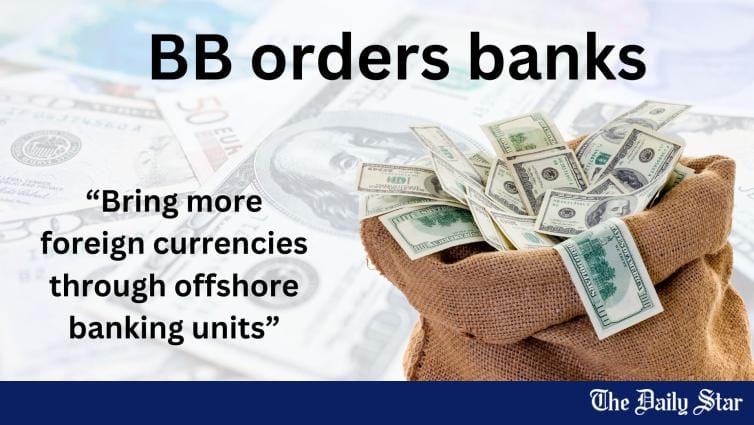
Bangladesh Bank has asked managing directors of different banks to find out ways to raise foreign currency inflow to give a boost to the country depleting forex reserves.

They were also ordered to bring foreign currencies through banks' offshore banking units as the central bank has recently relaxed the rules for such units.

Bangladesh Bank Governor Abdur Rouf Talukder made the call in a meeting with the managing directors of five leading private commercial banks— Brac, City, Eastern, Mutual Trust and Dutch-Bangla—at the BB headquarters in Dhaka today.

Bangladesh has huge payments to make in the days to come, but its forex reserves continue to fall, as it stood at $19.97 billion as on April 24, down from $23.3 billion in July 26 of last year, BB data showed.

Meanwhile, the Offshore Banking Act 2024 passed in parliament on March 5 has barred the government to charge any tax on the profits that foreigners make in the offshore banking units of Bangladeshi banks.​
 

Rationalise tariff to protect local industry
Entrepreneurs demand

1714347675897.webp


Entrepreneurs yesterday emphasised the need to follow Bangladesh's tariff policy when imposing duties on imported goods.

They raised the issue at a seminar, titled "Role of Bangladesh Trade and Tariff Commission in protecting interests of local industries".

The event was organised by the Chittagong Chamber of Commerce and Industry (CCCI) at the World Trade Centre in the port city.

Omar Hazzaz, president of the CCCI, chaired the event while Ahmed Munirus Saleheen, chairman of the Bangladesh Trade and Tariff Commission, spoke as chief guest.

Shish Haider Chowdhury, a member of the commission, presented a paper while Customs Commissioner Faizur Rahman spoke as special guest.

Speakers also highlighted the need to protect local industries and also requested the commission to rationalise tariffs so that local industries can do better.​
 

Latest Posts

Back