โ˜• Support Us โ˜•
[๐Ÿ‡ง๐Ÿ‡ฉ] - Save the Rivers/Forests/Hills-----Save the Environment | Page 14 | PKDefense

[๐Ÿ‡ง๐Ÿ‡ฉ] Save the Rivers/Forests/Hills-----Save the Environment

Reply (Scroll)
Press space to scroll through posts
G Bangladesh Defense
[๐Ÿ‡ง๐Ÿ‡ฉ] Save the Rivers/Forests/Hills-----Save the Environment
493
12K
More threads by Saif


Donโ€™t invest in polluting industries
Rizwana asks banks

Syeda Rizwana Hasan, adviser to the Ministry of Environment, Forest and Climate Change, has urged banks in Bangladesh not to invest in heavy polluting industries as a part of their responsibility to protect the environment.

She made this plea while addressing an event organised by BRAC Bank at the InterContinental Dhaka in the capital yesterday.

At the event, BRAC Bank launched its Sustainability Report 2023, titled "Bloom into the Future".

Rizwana, who was present as chief guest of the programme, said all banks in the country need to invest in sustainable businesses and renewable energy.

Highlighting the importance for environment-friendly investment, Rizwana said she is scared to know that some banks are investing in shipbreaking.

She also praised BRAC Bank for its efforts in disclosing its sustainability agenda.

"I envision a future where sustainability is integrated into every aspect of life, from urban planning to agriculture, which means embracing innovative solutions such as green finance, circular economy practices, and sustainable technologies," Rizwana said.

BRAC Bank has taken steps in this direction, and its initiatives in green finance can serve as a model for others looking to scale their impact and contribute to a greener, more resilient economy, she added.

Bangladesh Bank Deputy Governor Nurun Nahar emphasised the central bank's dedication to promoting a culture of sustainability disclosures among banks.

She said sustainability ratings do not simply measure performance, they also demonstrate a bank's dedication to long-term growth that considers economic advancement, environmental protection and social responsibility.

"At Bangladesh Bank, we believe incorporating sustainability into banking practices is crucial for constructing a robust and inclusive future," Nahar added.

BRAC Bank Chairman Meheriar M Hasan said sustainability is no longer a choice, but a responsibility in the modern banking industry.

"BRAC Bank has been a proud advocate of sustainable banking practices, both in Bangladesh and on the international stage," he added. "We believe finance must serve a higher purpose -- one that supports people, the planet and long-term prosperity. The report encapsulates the bank's purpose and actions in sustainability frontiers."

BRAC Bank Managing Director Selim RF Hussain said the report is a tangible manifestation of their commitment to values-based, responsible, and sustainable banking practices that promote economic growth while considering social and environmental factors.

"The theme 'Bloom into the Future' reflects our vision of a flourishing and inclusive future, where sustainability and financial prosperity coexist," he added. "We are not just growing as a bank; we are reshaping the future of banking to serve a higher purpose."

The report underscores the bank's dedication to a sustainable future and follows the Global Reporting Initiative framework. It also provides a comprehensive look at the bank's sustainability strategy, focusing on its impact on the environment, society and governance.

By publishing this report, BRAC Bank has reinforced its position as a leader in meeting environmental responsibilities within Bangladesh's financial sector.

The bank's commitment to responsible financing, good governance and combating climate change is evident through its transparency and sustainability practices.​
 

Little efforts to reclaim grabbed forest land in Bangladesh
Rashad Ahamad 19 October, 2024, 00:23

1729298421373.png

File photo

A vast area of forestland remained grabbed by different quarters for decades but the authorities took no effective measures to reclaim the land even after the change in government in early August.

The interim government, formed on August 8 after the fall of the Sheikh Hasina regime amid a student-led mass uprising on August 5, has failed to evict grabbers despite repeated calls from different quarters.

The chief conservator of forest Amin Hossain, however, claimed that they were now reclaiming grabbed forestland faster than they did earlier.

He said that, in the cases of grabbing involving political persons, the forest department could not play an appropriate role in the past, but now they were conducting drives to reclaim such grabbed land.

The forest department owns a total of 46,00,000 acres of land. The lands are either marked as โ€˜reserved forestsโ€™ or โ€˜protected forestsโ€™.

According to the latest and the lone countrywide survey by the forest department in 2021, at least 1,60,000 grabbers illegally occupied at least 2,56,000 acres of forestland since the countryโ€™s independence.

The forest department, between 2021 and June this year, reclaimed 31,000 acres of land from illegal grabbers mostly in Hill Tracts, Sylhet, Gazipur, Mymensingh and Tangail.

After the fall of the Sheikh Hasina regime, the department reclaimed nearly 500 acres grabbed by the Awami League leaders.

Besides ruling party men during different governments, locally influential people and industrialists grabbed the forestland over the years which took a new dimension after 2010 when AL was in power.

Chittagong Universityโ€™s forestry and environmental sciences professor Mohammed Al-Amin said that forestland was an unlocked land. โ€˜In a land-hungry country like Bangladesh, the forestland is more vulnerable. Forest coverage has been declining gradually.โ€™

โ€˜Political power is very much integrated with this grabbing process. Sal forest is more vulnerable than other forests in the country,โ€™ he said.

He blamed the lack of political will and the crisis of manpower and logistics for the inaction of the forest department.

โ€˜Certainly, some forest department officials are involved in the unholy nexus with grabbers,โ€™ he said.

Industries, resorts and farms are significant establishments on the grabbed forest land. Government institutes and places of worship were also constructed by grabbing forest land.

Amin Hossain said that they logged several thousand cases and sent eviction requests to the respective deputy commissionersโ€™ offices but the DC offices took little measures.

He estimated that eviction requests to the DCs were sent to reclaim at least 250,000 acres of land.

After the fall of the AL government, the forest department reclaimed 200 acres of land grabbed by former environment minister Hasan Mahmudโ€™s brother at Rangunia in Chattogram and 15 acres of land grabbed by former agriculture minister Mohammed Abdus Shahid in Moulvibazar.

On Wednesday, the forest department reclaimed 155.09 acres of land in Coxโ€™s Bazar and Chattogram. The lands were grabbed by the Bangladesh Forest Industries Development Corporation.

The land was reclaimed after special directives from the environment, forest and climate change advisor Syeda Rizwana Hasan, officials said.

Forest officials said that 11,000 acres of forest land under Gazipur Circle were recorded as private property over the years.

The forest department also filed cases for the correction of the records.

Officials said that they could not conduct drives against the influential grabbers in the past one and a half decades due to political influence.

The forest department asked officials concerned to make a fresh list of grabbers as soon as possible to conduct fresh drives.

Owing to factors such as grabbing, over-exploitation, conversion of forest land into agricultural land, forest resources in Bangladesh have been continuously depleting in terms of both area and quality.

According to the Food and Agriculture Organization, between 1990 and 2015, Bangladesh annually lost 2,600 hectares of primary forest. Primary forest land gradually decreased from 1.494 million hectares in 1990 to 1.429 million hectares in 2015.

Society for Environment and Human Development executive director Philip Gain said that the forest departmentโ€™s list of grabbers was not flawless.

He said that the names of many national minority people living traditionally in the forests were included in the grabbersโ€™ list.

Urging the government to evict grabbers and reclaim grabbed forest land, he said that sal forest land was grabbed by industries while coastal forest land was grabbed by people for making shrimp enclosures due to the governmentโ€™s wrong decision.​
 
In blind pursuance of materiality, people have forgot the basics. The basics are preserving soil quality i.e make it more fertile by organic material addition, water quality, water conservation, tree plantation and forestation etc. We keep cutting forests and build concrete jungles.
 
In blind pursuance of materiality, people have forgot the basics. The basics are preserving soil quality i.e make it more fertile by organic material addition, water quality, water conservation, tree plantation and forestation etc. We keep cutting forests and build concrete jungles.
Totally agree with you. In Bangladesh people cut trees in a festive mood. They have no regards for environment.
 

Take stern action to protect our environment
Ineffectiveness of government measures raises concerns

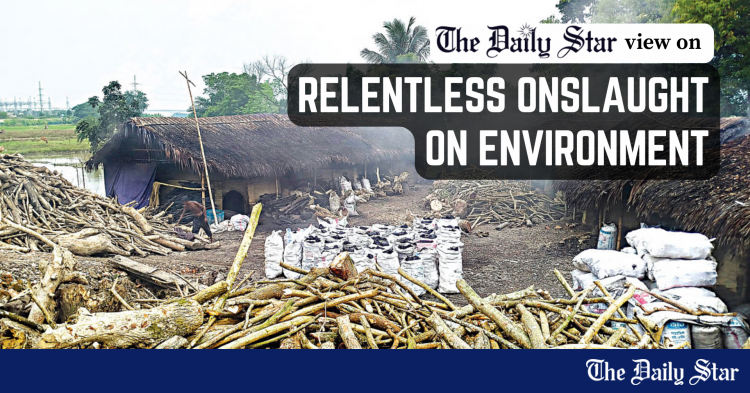
1729382075185.png

VISUAL: STAR

It is frustrating to see the relentless onslaught on our nature even now. Indiscriminate hill cutting, deforestation, encroachment of water bodies including riverside areas, illegal sand lifting, and rampant tree fellingโ€”all are happening as before with the relevant authorities failing to prevent them. Almost every day, we see news of some environmental degradation somewhere in the country. The continuation of this situation even after the fall of the Awami League government and the installation of a pro-environment leadership is alarming.

For example, a photo published on the front page of this daily on October 17 revealed one such incident, which showed a hill being cut to make way for housing at Tukerbajar union in Sylhet Sadar. Reportedly, at least six hills have been cut in the area recently. What's more alarming is that, despite locals' complaints, neither the Department of Environment nor the district administration took any action to halt this destruction. The front page of our October 18 issue again published a photo showing how illegally sourced logs were being burnt inside makeshift furnaces in Khulna's Rupsha upazila, leading to environmental pollution. Another report published on October 17 reveals illegal sand extraction at the Raghunandan Hill Reserve Forest in Habiganj. While hill-cutting is directly linked with landslides, sand extraction exacerbates soil erosion and increases landslide risks.

The question is, how can individuals destroy hills, illegally extract sand or fell trees right under the administration's nose? Over the years, this daily has published numerous reports exposing such illegal practices and written countless editorials urging the authorities to take action against those involved. Yet, nothing seems to stir their conscience. Earlier this year, we witnessed local influentials ravaging a hill in Chinipara of Bandarban's Chimbuk area to build a road to transport illegally felled trees. More recently, local influentials cut off the top of Nagin Pahar, a hill in Chattogram, for residential construction. And just the other day, reports emerged about the Water Development Board felling 50,000 trees to collect soil for an embankment in Khulna's Koyra upazila.

Sadly, in all these instances, local administrations either remained silent or were themselves complicit. We know how individuals connected with the previous regime directly engaged in anti-environment acts, but to see this practice persist after regime change questions the sincerity of the present administration. Reportedly, in many cases, AL-affiliated individuals have been replaced by BNP-affiliated ones. We urge our environment adviser to investigate these matters and take stern action against anyone involved in activities detrimental to the environment. We have ample laws for environmental protection; it is time to put them to proper use.​
 

Reclaiming forests should be a policy priority
20 October, 2024, 00:00

PROPER conservation of forest land is considered foundational in maintaining ecological balance, managing rising temperatures, and protecting habitat in times of natural disasters, but Bangladesh has lost 4.58 lakh acres of forest land, including 1.38 lakh acres of reserve forests, in 70 years since the completion of the cadastral survey in 1940. A recent survey of the forest department reported that at least 160,000 grabbers illegally occupied about 256,000 acres of forest land since the countryโ€™s independence. In 2021โ€“2023, the forest department reclaimed 31,000 acres of land from illegal grabbers. Of the 11,000 acres of forest land in Gazipur and Dhaka, a large share is encroached by big businesses and politically influential quarters. During the tenure of the recently deposed Awami League, recovering encroached forest land was a challenging task as a nexus of politicians, forest officials, and law enforcers were involved in the encroachment of forests. In the changed political context, with the fall of the AL regime in August and the interim governmentโ€™s expressed commitment to environmental causes, it was expected that recovering stolen forest land would be expedited, but that has not been the case. The forest department has recovered only about 500 acres of forest land in the past two months.

Environmentalists have expressed deep concern about the rapid deforestation in the country, as it is gravely impacting the countryโ€™s biodiversity, air quality, and general climate condition. Conservationists have reported that at least 31 wild life species are already extinct, and another 391 such species are declared endangered unless their living environment, that is, the forests, is protected. There are High Court orders that any notified forest area, no matter whether declared reserved forest or not, could not be allotted or leased for any purpose that would damage the countryโ€™s forest. Yet, at least 22 projects taken up by the AL government are on forest land between Mirsharai of Chattogram and Teknaf of Coxโ€™s Bazar. The Mirsharai mangrove forest, which spanned across 22,500 acres of land, was created by the coastal division in 1976; now most of it has been leased out to the Bangladesh Economic Zone Authority. There are other similar instances. The interim government has been reviewing development projects, and it cancelled some mega projects considering the huge expense involved, but no similar move was taken considering the environmental cost.​
 
Totally agree with you. In Bangladesh people cut trees in a festive mood. They have no regards for environment.

Sadguru has a great mission. He wants to reestablish the flow of Kaveri which happened to be few decades ago. It is named as Kaveri calling. He has planned to plant 2430 million trees in Kaveri basin.
 

Members Online

Latest Posts

Latest Posts