[🇧🇩] Textile & RMG Industry of Bangladesh

[🇧🇩] Textile & RMG Industry of Bangladesh
458
20K
More threads by Saif

G Bangladesh Defense

SILVER LINING NOW SHINES ON APPAREL HORIZONS
Narrow product range risks RMG sector’s sustainability


Monira Munni
Published :
Aug 19, 2025 00:10
Updated :
Aug 19, 2025 00:10

1755560237053.webp


Bangladesh long banks on few items for apparel-export earnings, risking the sector's sustainability, although diversification with high-value products suiting growing global- market trends holds great potential, trade experts say.

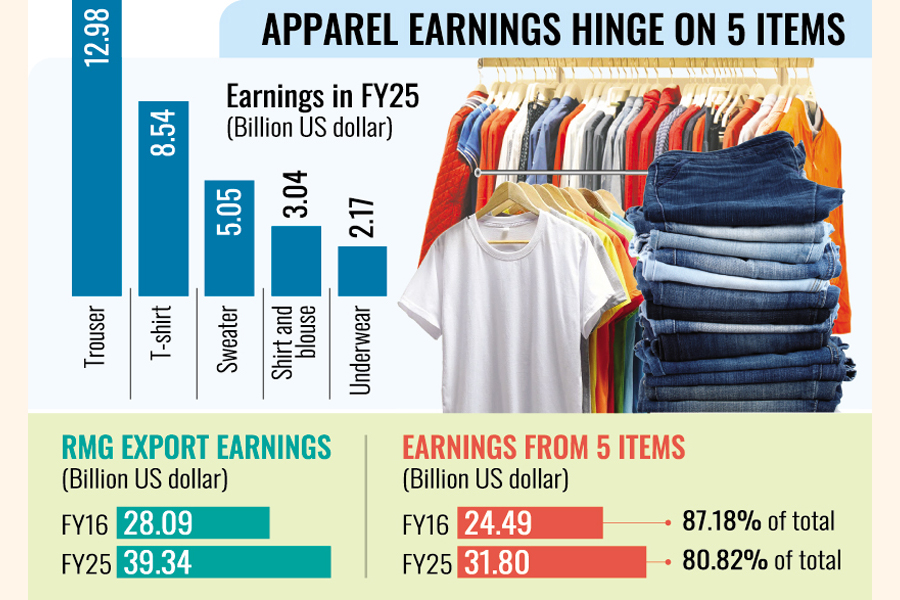
Five traditional items from the country's main export sector- trousers, T-shirt, shirt, sweater, and underwear - contributed about 80.82 per cent of the total readymade garment (RMG)-export earnings in the past financial year (FY25), according to Bangladesh Garment Manufacturers and Exporters Association (BGMEA) data.

The country exports more than 30 types of garment products, according to industry people.

Knit-and woven-apparel exports together fetched $39.34 billion in FY25. Of the earnings, the five items contributed $31.80 billion.

Back in FY16, the aforesaid items of common use brought in $24.49 billion, while total RMG export earnings were $28.09 billion, data showed.

During the last decade, underwear exports more than doubled while trousers fetched the highest earnings. On the other hand, shirt earnings remained almost static.

Of the $31.80 billion earnings in the just-past fiscal year, $12.98 billion came from trousers, $8.54 billion from T-shirt, $5.05 billion from sweater, $3.04 billion from shirt and blouse, and $2.17 billion from underwear.

The country's total export earnings stood at $48.28 billion during the last fiscal year, with apparel accounting for an overwhelming 81.49 per cent, data showed.

Exporters and experts opine that Bangladesh largely produces basic items mostly based on cotton. "Though the global market is switching to man-made fibre (MMF)-based garments from the natural fibre of cotton, the situation of Bangladesh looks opposite," they note by one voice, stressing the need for the RMG sector's diversification.

They have, however, said diversification is happening gradually, especially in denim, dyeing, and washing segments.

Besides, the critics blame the absence of effective steps for product diversification according to market demands and exploration, poor infrastructure, and entrepreneurs' unwillingness to take risks.

"Such dependency on a single sector and a few items might put the overall export earnings at risk," says one trade expert, recommending effective measures and government policy support to increase the competitiveness of local products, including non-apparel items, and exploring the untapped markets across the world.

Fazlee Shamim Ehsan, executive president of Bangladesh Knitwear Manufacturers and Exporters Association (BKMEA), told The Financial Express that diversification is taking place gradually and items on the top-five list also changed during the last decade, with underwear/lingerie entering the basket.

He explains that there are three types of value addition - country base, inside products, and profit.

"The first two are rising as they source local raw materials mostly for knit items and necessary accessories, though value addition in terms of profit has declined," he notes.

Explaining the risk of confining to a few items, Mr Ehsan added that as most of them produce basic items, it has developed higher capacity compared to the global demand, which resulted in price pressure.

Inamul Haq Khan, senior vice-president of the BGMEA, says 70 per cent of the global demand is for MMF-based garments, while Bangladesh produces 70-75 per cent of its exportable based on cotton, which runs counter to the global trend of the day.

To raise export earnings from RMG products, he says, exporters need to go for MMF-based garments to sustain in the competition and get better prices like Vietnam.

His factory's export earnings are growing, though the number of factories or their capacity has not increased, says the leading exporter, adding that it is because they produce high-value-added items.

Bangladesh mostly makes items for which the free on board (FOB) is $6-8 per piece on average, while it gets $12-15 for cut and make (CM) - which means stitching for a garment - and there are products that bring CM of $30 per piece.

Both leaders have said the country needs investment in the backward-linkage textile sector to produce raw materials needed for MMF-based garments as Bangladesh has to meet the requirements for such materials imported from China and India.

Textile millers also stressed diversification in the textile sector to manufacture blended, as well as MMF- and non-cotton-based, yarns and fabrics to sustain business in the long run and face the emerging challenges stemming from tariffs and post-graduation market access.

According to industry-insiders, Bangladesh's synthetic yarn industry is small and cannot meet the domestic demand for MMF yarns.

That is why the country imports most of the manmade yarns and fibres used in apparel exports, they said. Till 2023, Bangladesh had 19 synthetic spinning mills, including eight acrylic ones, they added.

A new diagnostic report by the World Bank, the International Finance Corporation (IFC), and the Multilateral Investment Guarantee Agency (MIGA) says Bangladesh's RMG sector could be on the cusp of a transformative leap, with the potential to earn up to $94 billion in annual export earnings by 2029 if it expands into non-traditional markets and embraces MMF-based garment production.

This ambitious earning amount is expected to be achieved at an average annual growth rate of 15 per cent, which would require coordinated reforms across trade, industry, and finance, it adds.​
 

Import of RMG raw materials rises by 9.9pc
Staff Correspondent 17 August, 2025, 23:47

1755563368770.webp

File photo shows workers are at duty at a garment factory in the city. | New Age photo

The country’s imports of raw materials for the readymade garment sector witnessed a growth of 9.9 per cent in the financial year 2024-25, according to Bangladesh Bank data.

According to the data, the country imported raw materials for the RMG sector, including raw cotton, yarn, staple, and other accessories, worth $18.44 billion. The amount was $16.78 billion in FY24.

The central bank published the commodity-wise annual import data through the customs records.

In FY25, Bangladesh earned $39.35 billion by exporting RMG products, the highest export-earning sector. This was an 8.84 per cent increase from $36.15 billion in FY24.Bangladesh travel packages

The RMG sector accounted for more than 80 per cent of the country’s $48.28 billion worth of export earnings in FY25, said Export Promotion Bureau data.

The net exports from the RMG sector totaled $20.91 billion in FY25, according to central bank data.

Among the primary raw materials, raw cotton imports experienced a decline of 4.3 per cent to $3.46 billion, down from $ 3.60 billion in FY25.

Bangladesh imported yarn worth $3.61 billion in FY25, 12.3 per cent higher than $3.22 billion in FY24.

Textile and other related articles imports experienced a 16 per cent growth to $8.69 billion in FY25, up from $7.72 billion in FY24, according to the central bank data.

Staple fibre imports stood at $1.53 billion, representing a 10 per cent increase from $1.39 billion in FY24.

In FY25, the country imported dyeing and tanning materials worth $877 million, a 5.2 per cent increase from $833.7 million in FY24, according to Bangladesh Bank data.

Bangladesh Garment Manufacturers and Exporters Association senior vice president Inamul Haq Khan told New Age that the values of exports, imports, and net exports demonstrated the stable situation of the country’s RMG sector.

‘The FY25 was an excellent year for us and we are hopeful that the current FY26 will also be a positive year,’ he added.Bangladesh travel packagesNew Age subscription

The United States has recently revised the reciprocal tariff for Bangladesh to 20 per cent, almost the same as its major competitors, except for India, which has been slapped with a 50 per cent tariff.

Inamul Haq expressed optimism that, for this reason, some orders might shift from India to Bangladesh.

‘Moreover, we are also in a good shape at European and other markets, so import of raw materials might increase in the current FY26,’ he added.

He urged the government to address the domestic bottlenecks, including energy shortage, port and customs issues, ease of doing business, and banking issues, to ensure a better business environment.

‘If we get sufficient policy support, we have the ability to reach targets as we are getting better purchase orders,’ he added.

However, the import of capital machinery experienced a negative growth of 19.1 per cent to $2.81 billion in FY25, compared to $3.48 billion in FY24, according to Bangladesh Bank data.

The other capital goods import also experienced negative growth of 5.9 per cent to $6.7 billion from $7.15 billion in FY24.

Exporters said that this decline was mainly due to political transition and uncertainty, which discouraged entrepreneurs from making new investments.​
 

Reforms and diversification key to boosting RMG

Wasi Ahmed
Published :
Aug 20, 2025 00:18
Updated :
Aug 20, 2025 00:18

1755646549066.webp


For decades, policy circles and industry stakeholders have repeatedly stressed the need for reforms and diversification to rejuvenate the country's readymade garment (RMG) exports. Reforms essentially imply structural changes in production and operations, with a strategic shift from low-end, mass-volume products to high-end or semi-high-end categories that effect higher value addition. Diversification, on the other hand, refers not only to broadening the range of apparel products but also to extending export reach beyond the conventional markets of North America and the European Union. Although some progress has been made on both fronts, the pace has been far slower than the required. In today's rapidly changing global trade dynamics -- especially involving apparel exports -- the challenges are more complex than they were a decade ago, forcing Bangladesh at a crossroads.

Despite the difficulties, optimism persists that Bangladesh can still make a transitional leap in apparel exports. A recent diagnostic report prepared jointly by the World Bank, the International Finance Corporation, and the Multilateral Investment Guarantee Agency highlights this potential. According to the report, Bangladesh's RMG sector could generate as much as US$94 billion in annual export earnings by 2029, provided that the industry actively expands into non-traditional markets and embraces manmade fibre (MMF) production in a big way. Achieving this ambitious target would require sustaining an average annual growth rate of 15 per cent -- a formidable challenge that demands wide-ranging, coordinated reforms across trade policy, industrial operations, and financial systems.

The report also identified four sectors in Bangladesh with the highest growth potential where private investment could play a transformative role. These include the RMG, middle-income housing, domestic production of textile dyes and paints, and digital financial services. The findings also shed light on broader concerns such as foreign direct investment (FDI) trends, the overall business climate, and cross-cutting regulatory bottlenecks that hinder private sector growth. The clear message is that while Bangladesh's growth prospects remain bright, achieving them will require regulatory clarity, accelerated digital transformation, and establishment of a more inclusive and investment-friendly climate.

The United States, Bangladesh's single largest apparel export destination, is likely to play a particularly pivotal role in this anticipated prospect. Recent tariff actions by the US, targeting multiple countries including some of Bangladesh's competitors, carry important implications for Bangladesh's RMG exports. The US tariffs are largely aimed at curbing Chinese exports. Consequently, many American apparel brands and retailers are now adopting a strategy of geographical diversification in sourcing to reduce over-dependence on China. Rising tariff rates on Chinese apparel and the intensifying strategic rivalry between Washington and Beijing have prompted several leading US fashion companies to scale down their sourcing from China -- some planning to reduce it to single-digit percentages, and others even considering moving out of China altogether.

This geopolitical and trade reorientation presents Bangladesh with a unique window of opportunity. With China's declining market share in the US and the search for alternative sourcing bases, Bangladesh could secure a larger slice of the American apparel market. The numbers tell the story: China's share of the US apparel import market dropped from 37.7 per cent in 2013 to 21.3 per cent in 2023. During the same period, Bangladesh's share rose from 6.0 per cent to 9.0 per cent. Vietnam has also been a major beneficiary, expanding its share from 10 per cent to 17.8 per cent. India, Cambodia and Pakistan, too, recorded modest gains. Clearly, the global sourcing map is shifting and Bangladesh stands to benefit if it can position itself strategically.

The critical question, however, is whether Bangladesh is ready to seize this opportunity. Industry insiders point out that despite clear signals of shifting demand, fresh investment to expand production capacity -- especially in MMF-based and other high-value apparel items -- has been limited. The country still depends heavily on imported raw materials for producing value-added garments, particularly MMF-based products. Without building domestic capacity in this area, Bangladesh risks missing out on lucrative future orders. Moreover, structural challenges such as energy shortages, rising utility costs, and persistent logistics bottlenecks continue to undermine the country's competitive edge.

Local exporters, however, remain cautiously optimistic. They argue that with its existing scale and experience, Bangladesh already has the capability to absorb some of the work orders likely to be diverted from China. The competitive edge lies in cost efficiency, skilled workforce, and a strong reputation as a reliable supplier. But for this to translate into long-term market resilience, the country must urgently address its internal weaknesses. Expansion of investment in MMF production, reliable energy supply, upgrading of port and transport infrastructure and removal of bureaucratic bottlenecks are the key imperatives.

Another important trend is the pricing strategy of US fashion companies. Even amid rising costs from tariffs and supply chain adjustments, these companies have largely avoided widespread retail price hikes. Instead, they have absorbed some of the cost pressures internally while maintaining their sourcing diversification strategy. This signals that buyers are looking for competitive suppliers who can ensure flexibility, speed and quality without significantly raising end prices. Bangladesh's ability to align with this evolving buyer preference will be decisive in slicing greater market shares.

Industry leaders repeatedly emphasise that a strategic shift from low-end to high-value apparel is no longer optional but essential. Bangladesh must move beyond being predominantly a producer of basic garments to one that specialises in design-driven, technologically advanced, and higher-margin items. At the same time, exploring new and emerging markets outside the US and EU is crucial. Countries in East Asia, Latin America, and Africa represent untapped potential that could further diversify Bangladesh's export portfolio and reduce dependence on a few large markets.

The pathway to revamping Bangladesh's RMG sector lies in a dual strategy of reforms and diversification. Reforms must focus on upgrading the industry to produce more high-value products supported by stronger backward linkages in MMF and other inputs. Diversification must go beyond products to include new markets. The opportunities created by the shifting global trade dynamics are real, but seizing them will require vision, investment and matching strategic policy.​
 

Apparel exports to EU rise by 17.9pc in H1
Moinul Haque 20 August, 2025, 00:50

1755650407870.webp

A file photo shows female workers sewing clothes at a readymade garment factory in Dhaka. | New Age photo

Bangladesh cemented its position as the European Union’s second-largest apparel supplier in the first half of 2025 with exports up 17.9 per cent to 10.29 billion euros, but its growth was eclipsed by China’s 22.3 per cent rise and Cambodia’s 30.4 per cent surge, signalling severer competition in the EU market.

According to Eurostat data released on Monday, EU apparel imports from Bangladesh rose to 10.29 billion euros in January–June 2025, up from €8.73 billion in the same period of 2024.

Knitwear was the main driver, rising by 21.1 per cent to 6.03 billion euros, while woven garments increased by 13.6 per cent to 4.26 billion euros.

Exporters said the higher growth showed that EU demand for garments was rising and the market there was improving, but they were concerned about growing competition among major producers following the US’s new tariffs on many Asian garment-producing countries.

They said the high US tariffs, especially on India and China, had pushed these countries to focus more on the EU to make up for losses in the US market.

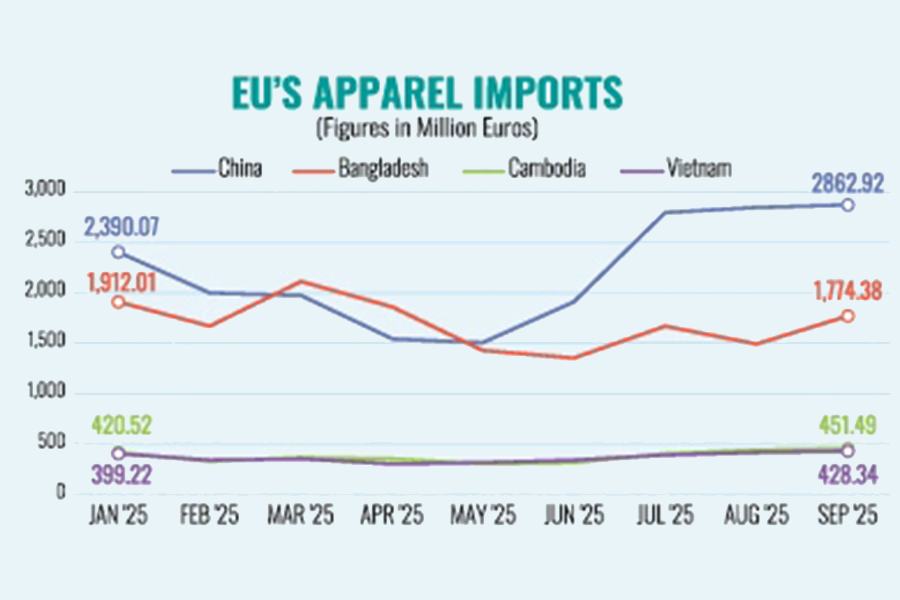
The year started strongly, with exports in January 2025 reaching 1.91 billion euros, a 61 per cent rise from 1.19 billion euros in January 2024.

February followed with 1.66 billion euros, 28 per cent higher than a year earlier, and in March exports rose further to 2.11 billion euros, an 18 percent increase.

In April 2025, Bangladesh’s apparel exports to the EU stood at 1.86 billion euros, just six per cent higher than April 2024.Bangladesh history book

In May, exports fell to 1.42 billion euros, 11 per cent lower than the 1.59 billion euros of the previous year, marking the first monthly drop in the year.

June saw a small recovery, with exports rising to 1.33 billion euros, 19 per cent higher year-on-year, although still slightly below May on a monthly basis.

Bangladesh Knitwear Manufacturers and Exporters Association former president Fazlul Hoque said the overall growth showed the market was improving, as almost all major producing countries had double-digit growth.

He said that Bangladesh could do better if there was no internal problems, such as factory closures and banking difficulties, which had slowed further growth.

Fazlu, also managing director of Plummy Fashions Ltd, said that because of trade tensions between China and the US, China was losing US market share.Bangladesh history book

He warned that China was increasing its focus on the EU and would continue to do so, and that India would likely follow, making competition in the market very strong.

When compared with other leading suppliers, Bangladesh’s growth in the first six months of 2025was higher than the EU’s overall apparel import expansion of 12.3 per cent.

Data showed that the EU apparel imports increased to 43.39 billion euros in the first half of 2025, up from 38.64 billion euros in the same period of 2024.

Knitwear led the gains with a 14.7 per cent rise to 21.87 billion euros, while woven apparel grew 10 per cent to 21.51 billion euros.

Other competitors also showed solid improvements but did not match Bangladesh’s overall momentum.

China reinforced its dominance as the EU’s largest supplier, with exports rising 22.3 per cent from 9.20 billion euros in H1 2024 to 11.26 billion euros in H1 2025.Bangladesh history book

Cambodia led growth among major exporters, with EU apparel imports rising 30.4 per cent from 1.59 billion euros in H1 2024 to 2.07 billion euros in H1 2025.

India increased its apparel exports to the EU by 15.4 per cent to 2.70 billion euros in January-June of 2025.

Pakistan grew by 16.6 per cent to 1.86 billion euros, recording balanced gains across knit and woven segments.

Vietnam maintained strong double-digit expansion, up 17.3 per cent to 2.02 billion euros, broadly in line with Bangladesh’s percentage increase.

Turkey, traditionally an important supplier due to its geographical proximity, was the only major exporter to see a decline in the EU market.

EU apparel imports in the first half of 2025 from Turkey fell by 7 per cent to 4.27 billion euros, with both knit and woven categories in contraction​
 
Industrialist Nurul Islam Babul's daughter took the helm of Jamuna Group after he passed, she also heads part of BGMEA.

Story on their recent $100 Million (first tranche of total $500 Million) investment in synthetic (PET) fabric production.

 
newagebd.net/post/apparel/281897/rmg-exporters-see-high-value-garments-market-in-japan

RMG exporters see high-value garments market in Japan
Staff Correspondent 11 November, 2025, 23:35​

1762927771219.webp


The country’s readymade garment manufacturers could export high-value and trendy RMG items to Japan as they have shown a keen interest to source more high-value RMG items, said the exporters.

They also said that with Bangladesh’s growing capacity for high-value production, Japanese buyers now have increased confidence in the country as a sourcing destination.

A delegation from the Japan Textile Importers Association expressed their interest during a meeting with the leaders of the Bangladesh Garment Manufacturers and Exporters Association on Monday evening.

According to a press release issued by the BGMEA, the discussions centred on ways to enhance bilateral trade, particularly through expanding garment exports from Bangladesh to Japan.

BGMEA president Mahmud Hasan Khan said Bangladesh’s garment industry is now strategically focused on market diversification, identifying Japan as a highly important and promising market.

‘The apparel sector is moving beyond basic cotton-based items to synthetic and technical textiles, aiming to shift the product mix towards the high-value segment,’ he said, urging Japanese buyers to increase their sourcing from Bangladesh.

The Japanese delegation praised Bangladesh’s achievements in ensuring social and environmental compliance, as well as efforts to improve worker safety and welfare.

The meeting also addressed issues related to supply chain efficiency.

The JTIA representatives said that Japanese buyers attach utmost importance to short lead times and suggested simplifying Bangladesh’s customs procedures and enhancing the operational efficiency of the Chattogram port to facilitate smoother trade.

The BGMEA leaders urged the delegation’s cooperation in easing the visa process for Bangladeshi businesspeople travelling to Japan.

In response, the JTIA representatives assured that they would raise the issue with relevant Japanese authorities.

The BGMEA also sought data and research on international market trends from the JTIA to support strategic planning for export diversification.

The two sides also discussed the potential impact of Bangladesh’s LDC graduation in 2026, including tariff implications in key export markets.

The BGMEA president urged Japan, through the JTIA, to consider extending duty-free market access for Bangladesh even after graduation, possibly under a mutually beneficial framework such as an Economic Partnership Agreement or Preferential Trade Agreement.

The JTIA delegation included representatives from top Japanese apparel brands where BGMEA vice presidents and directors were also present at the meeting.​
 
newagebd.net/post/apparel/282228/rmg-exports-to-the-eu-see-13pc-growth

RMG exports to the EU see 13pc growth
Staff Correspondent 15 November, 2025, 22:39

1763257729008.webp


Bangladesh’s exports of readymade garments to the European Union countries grew by 13.17 per cent year-on-year in the January-September 2025 period, reaching €15.26 billion, according to Eurostat data released recently.

The export earnings were €13.48 billion in the same period of 2024.

Bangladesh’s monthly exports to the EU in September of 2025 also grew by 15.47 per cent to €1.78 billion, compared with €1.54 billion in September of 2024.

RMG exporters said that, although the exports to the EU market are normal so far, the United States’ tariff policy has significantly impacted the global apparel industry, leading to shrinking demand.

For this reason, China and India have intensified their presence in the EU to offset their losses in the US market, which might increase competition here.

Bangladesh remained the second-largest apparel exporter to the EU after China, consolidating its position with double-digit growth in 2025.

The country’s 13.17 per cent rise outpaced the EU’s overall import growth of 7.14 per cent, reflecting Bangladesh’s competitiveness in terms of price, compliance, and sustainability credentials.

The European Union’s total apparel imports reached €68.47 billion in the first nine months of 2025, marking a 7.14 per cent year-on-year increase from €63.90 billion in the same period of 2024.

The EU’s imports also surged by 3.17 per cent to €8.57 billion in September 2025.

Among the major exporters, China, while maintaining its dominance, recorded 9.86 per cent growth during the first nine months of 2025, with export earnings rising to €19.77 billion from €18 billion in the same period of 2024.

However, its exports dropped slightly by 4.55 per cent in September 2025 to €2.87 billion, down from €3 billion a year earlier.

Despite securing third place, Turkey also experienced one of the sharpest declines among major suppliers in the EU market.

The country’s apparel exports to the EU fell to €6.42 billion in January-September 2025, a 9.8 per cent drop from €7.12 billion in the same period of 2024, Eurostat data added.

Turkey’s monthly apparel exports to the EU in September 2025 also fell to €704 million, an 8.48 per cent drop from €770 million in the same month of 2024.

India recorded 10 per cent growth to €3.76 billion in January-September 2025, up from €3.40 billion in the same period of 2024.

In September 2025, the South Asian country posted a narrow growth of 0.22 per cent to €308 million, which was €307 million in September 2024.

Cambodia emerged as the strongest performer, registering the highest growth rate among major EU apparel suppliers in the first nine months of 2025, said the Eurostat data.

The country’s apparel exports to the EU rose by 22.51 per cent in January-September 2025 to €3.37 billion, which was €2.97 billion, while cumulative exports for the January-September period surged by 25.9 per cent to €2.74 billion in the mentioned period.

Vietnam and Pakistan also showed solid performance in the EU market, with apparel exports rising by 14.24 per cent and 13.77 per cent, respectively, in January-September of 2025, to €3.26 billion and €2.9 billion, respectively.

Vietnam’s growth was usually driven by its expanding synthetic apparel and sportswear industries and its preferential access under the EU–Vietnam Free Trade Agreement.

Mohammad Hatem, president of the Bangladesh Knitwear Manufacturers and Exporters Association, said that as the US tariff policy changed the global apparel market, China and India have intensified their presence in the EU.

‘This may increase competition in Europe and in this regard, Bangladesh should resolve several domestic factors, including gas and electricity shortages and challenges related to banking and customs,’ he added.

Mohiuddin Rubel, former director of the Bangladesh Garment Manufacturers and Exporters Association, said the scenario in Europe has changed significantly over the last three months.

‘Countries like China, Cambodia, Vietnam, and Pakistan increased their presence in EU markets to offset their losses in the US. Their exports to the EU increased more than the average in the last three months, although Bangladesh remained at its usual position,’ he added.

Bangladesh has started losing its share in Europe due to competitors’ aggressive presence, he added, saying the country should focus on product diversification, resolving domestic issues, and innovation to sustain its position there.

In 2024, Bangladesh exported apparel worth over €17 billion, according to Eurostat data.​
 

Trade paradigm shift over US high-tariff regime
Bangladesh garment export to EU confronting crowding-out effect

Monira Munni

Published :
Nov 16, 2025 08:15

1763342907632.webp


Bangladesh's garment export to the European Union faces crowding-out effect as major competitors, hitting US tariff walls, are making forays into the country's largest shipment destination, exporters say.

China, Vietnam, Cambodia and Pakistan have incrementally raised their concentration on the European Union (EU) market for a decade while they, mainly trade-major China, now intensify trade race as new US tariff regime comes into effect.

The ramped-up reciprocal tariffs force the players to diversify their shipment destinations to the 27-nation bloc in Europe.

Data analysis shows that China shipped garments, on average, worth of 1.87 billion euros each month from January to June of 2025 while the average shipments rose to 2.82 billion euros in July-September period of the current calendar year. The turnover takes China's overall garment shipments to the EU to 19.76 billion euros during the first nine months of 2025, according to Eurostat data.

On the other hand, Bangladesh's average single-month apparel-export earnings during the July-to-September period stood at 1.64 billion euros while the average monthly receipt was 1.71 billion euros during the first six months of 2025.

The country started 2025 with 1.91 billion euros in January, while the highest income worth of 2.11 billion euros was in March 2025. Export performance continued falling since April, save July and September, data analysis shows.

Apparel exports from the country fetched 15.25 billion euros, recording a 13.17-percent growth, during the last January-September period, in a rise from 13.47 billion euros in the corresponding period of 2024.

However, the single-month earnings missed the March mark.

Experts and exporters say constrained by American tariffs, supplies have been diverted to other key destinations, such as Japan, and Canada and mostly to the EU.

With Bangladesh holding over 20-percent share in the EU apparel market, this diversion could intensify price competition, squeezing margins and undermining profitability, they opine.

Asked about the latest trade situation, Fazlul Hoque, former president of Bangladesh Knitwear Manufacturers and Exporters Association (BKMEA), says data reflect Bangladesh's overall competitiveness gap with that of China.

"China's competitiveness is far better than that of Bangladesh with more efficient ports, no energy disruptions and uncertainty over political situation and national elections as here in the country while Bangladesh has low productivity, high lead time and cost of production," he explains.

"China, despite high wages there, is more competitive and able to instantly cope with the challenges, like as US tariff, with its high productivity, availability of raw materials like fabrics and no production disruption to diversify its destination, mostly to the EU," he told The Financial Express about the comparative advantages and disadvantages.

"Bangladesh can't compete only with cheap production-hub status."

Talking to the FE writer, Mohiuddin Rubel, a former director of Bangladesh Garment Manufacturers and Exporters Association (BGMEA), says though the average export growth of Bangladesh to the EU was good, the performances of other competitors, including China, Cambodia, Vietnam and Pakistan, were higher.

The last three moths' average shipment situation, especially after the new US tariff regime taking effect, has changed the overall market dimensions. On average, each month China shipped higher volumes of garments worth of 1.0 billion euros.

"In comparison, Bangladesh's average shipments during last three months since July rather decreased," he says, adding that competitors, mostly China, are entering the EU market aggressively by lowering prices significantly.

EU's apparel imports increased 7.14 per cent by value to 68.46 billion euros and 13.80 per cent by volume to 3.54 billion kilograms, showing a 5.86-percent decline in unit price during the January-to-September period of 2025 compared to that of 2024, statistics show.

Citing data, Mr Rubel says Indian apparel exports amounted to 3.76 billion euros during the first nine months of 2025, recording a 10.62-percent growth in value and 16.01-percent growth in volume, showing a 16.01-percent price fall.

Pakistan received 2.90 billion euros during the period, marking 13.77- percent rise in value, driven by 15.90-percent growth in volume and a 1.83-percent reduction in unit prices.

Cambodia posted particularly strong performance, with exports surging to 3.37 billion euros recording 22.51 per cent and 39.65 per cent growth in value and volume respectively.

Unit prices for Cambodia-made garments fell by 12.27 per cent, reflecting an assertive strategic shift towards the EU amid weaker conditions on the US market, he notes.

Unit price of Vietnamese garments, however, witnessed a 2.65-percent rise, he says, attributing their high value-added items.

"While these countries achieved robust volume and value growth, the broad-based decline in average prices highlights the intense competitive pressure within the EU apparel market as well as buyers' focus on cost containment in an inflationary environment," Mr Rubel, also additional managing director of Denim Expert Ltd, notes.​
 

Latest Posts

Back