[🇵🇰] Wildlife in Pakistan

[🇵🇰] Wildlife in Pakistan
59
4K
More threads by ghazi

G Pakistan Economic

Markhor population in Pakistan witnesses significant increase​

Markhor population reaches 5,621....

Asif Mehmood
November 15, 2023

photo wildlifeofpakistan


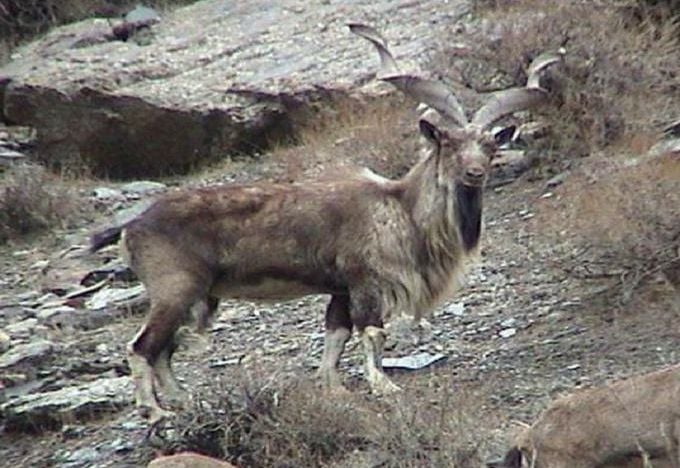
KHYBER PAKHTUNKHWA: The population of Pakistan's national animal, the Markhor, has witnessed a noteworthy surge in the province of Khyber-Pakhtunkhwa (K-P).

Renowned for its agility, long winter coat, and distinctive large spiral horns, the Markhor predominantly inhabits the lofty mountains of Chitral, Kohistan, and Kalam within the K-P province, as well as the northern Gilgit-Baltistan (G-B) region.

According to the Wildlife Department's recent findings, the Markhor population in K-P has experienced a substantial increase, reaching a count of 5,621.

This surge is attributed to heightened awareness regarding illegal hunting practices, showcasing a positive impact on conservation efforts. Notably, specific regions such as Swat and Kohistan have witnessed pronounced increments in Markhor populations.

The detailed breakdown reveals specific figures for Chitral, Kohistan, and Swat, indicating a population of 2,427, 660, and 159 Markhors, respectively. These numbers provide insights into the distribution and concentration of the wild goat species across different regions, shedding light on the success of conservation initiatives and the preservation of this iconic animal in Pakistan.

Likewise, in January 2023, the sighting of a rare Markhor in Chitral city generated considerable excitement among the local population. Subsequently, the male Markhor was successfully captured and released into a national park where hunting is strictly prohibited, as enforced by wildlife watchers.

tribune.com.pk


Markhor population in Pakistan witnesses significant increase | The Express Tribune

Markhor population reaches 5,621
 
Hope in Cholistan as houbara chicks hatch

Bhagwandas
April 08, 2020

5e8d255fa7a02.jpg


Houbara bustard hatchlings.


KARACHI: Amid all gloom and doom due to the coronavirus pandemic, some good news has come from the wildlife conservation in Cholistan desert where three chicks of a rare species of captive bred houbara bustard have hatched.

The birds of Pakistani bloodline were bred by a United Arab Emirates-based organisation and released by it in collaboration with a local non-governmental organisation in the southern Punjab desert last year.

At least some of the released birds, it seems, have survived the harsh conditions of Cholistan, laid the eggs which hatched giving hope that the birds have settled for breeding, indicating their liking for Pakistani desert temperature and food.

Responding to queries, chief of the Pakistani NGO, Houbara Foundation (HF), retired Brigadier Mukhtar Ahmed said that the birds of the bloodline of Pakistan’s resident population in Nag Valley (Balochistan) were bred in captivity by the UAE-based International Fund for Houbara Conservation (IFHC) and were brought in here last year. He said both organisations had released those birds in Cholistan desert.

The bustards were released into the desert last year

He said that transmitters were put on some of the released houbaras to monitor their locations and see if they stayed back, or travelled to central Asia along with the migratory houbara population. The transmitter-fitted houbaras’ movement is monitored through satellites by the IFHC.

Brig Ahmed said that some time back the IFHC informed the HF about the locations where some of the released houbaras were staying for many hours. Acting on the information, he added, survey teams of the HF were sent to those locations where they found the female birds brooding the eggs.

He said that the teams equipped with high-powered binoculars kept a vigil from a distance so as not to disturb the bird, which is very shy and sensing any threat would abandon the nest/eggs. In due time, the teams that had found the eggs also spotted the hatched chicks.

Since the birds belonged to the Nag Valley houbara population, he expressed the hope that as the situation improved in Balochistan the birds would be released there as well so that it could augment the resident population.

Published in Dawn, April 8th, 2020
 
Great spot: rare Persian leopard pair sighted in Pakistan

  • Baloch said there was no previous record of the creature ever being sighted in Pakistan.
AFP
21 May 2021

60a786a237e4f.jpg


QUETTA: A pair of rare Persian leopards sighted in Pakistan for the first time last year have been filmed and photographed in the wild, officials said Friday.

Sharifuddin Baloch, a senior conservation official in Balochistan province, said the pair were first spotted by rangers in the Hazarganji Wildlife Park six months ago.

Adult leopards are solitary in the wild and pair only to mate.

"We equipped our staff with cameras and binoculars to film the pair and take photos," Baloch said.

"This month our staff succeeded."

Persian leopards are a panther sub-species native to Turkey, Iran, Afghanistan and the Caucasus.

They are extremely rare, however, and listed by the International Union for Conservation of Nature (IUCN) as endangered.

Fewer than 1,000 are believed to exist in the wild, with another 200 in captivity.

"We are taking steps to protect the rare species," Baloch told AFP, adding officials were sharing data with the IUCN.

Video shot by park officials shows one of the leopards beautifully camouflaged on a rugged, rocky hillside until it stands up and pads away.

Baloch said there was no previous record of the creature ever being sighted in Pakistan.

Panthera tulliana is bigger and has a different spot pattern to the more common Indian leopard (panthera fusca) found across Pakistan.

Pakistan is also home to vulnerable snow leopards (panthera uncia) in the northern Himalayas.
 
Loss of nature poses risk to human health: Conservationist


Loss of nature poses risk to human health: Conservationist


https://nation.com.pk/NewsSource/haber

Anadolu
May 22, 2021

Nature and biodiversity do not top the global agenda despite the peril they face, says an official from a conservation organization who warns that losses to the natural world pose a major threat to the global economy, as well as people's health.

"The loss of nature is increasing our vulnerability to disease outbreaks, undermining efforts to tackle the climate crisis, and threatening livelihoods," Gavin Edwards of the World Wide Fund for Nature (WWF) told Anadolu Agency.

Speaking on the occasion of the International Day for Biological Diversity, observed annually on May 22 to increase understanding and awareness of biodiversity issues, Edwards pointed out the nature-based solution to the sustainability of a healthy planet.

"From nature-based solutions to climate, health issues, food and water security, and sustainable livelihoods, biodiversity is the foundation that sustains us all and in the aftermath of the COVID-19 pandemic, the safety net upon which we can build back better," said Edwards, who currently serves as the WWF's New Deal for Nature & People global coordinator.

This year's theme is "We're part of the solution," a slogan chosen to be a continuation of the momentum generated last year under the over-arching theme, "Our solutions are in nature," according to the UN.

Underlining that there is a strong link between nature loss and the risk of zoonotic diseases, which jump from animals to humans, Edwards said the novel coronavirus has shown that it was time for transformative action to preserve natural ecosystems and build nature-positive, carbon-neutral and sustainable societies.

Systematic change needed

"The COVID-19 crisis demonstrates that systemic changes must be made to address the environmental drivers of zoonotic disease outbreaks -- land-use change, expansion and the intensification of agriculture and animal production, and the consumption of high-risk wildlife," said Edwards.

Touching on how COVID-19 affected wildlife and biodiversity conservation efforts, he said thousands of rural tourism-based jobs would be at risk if action is not taken.

"Conservancies use their nature-based tourism income to sustain their natural resource management activities as well as supplement members' livelihoods and wellbeing with direct payments, or support for food, schooling and more," he added.

Citing a last year's report by the World Economic Forum (WEF) on the potential of a nature-positive economy that could generate more than $10 trillion in annual business value, he said the green recovery would not only create more jobs and more economic opportunity, but also help the world avoid future pandemics.

In response to a question about possible steps on protecting biodiversity and nature, Edwards said the Conference of Parties of the Convention on Biological Diversity was scheduled to take place Oct. 11 - 24 and added that world leaders were scheduled to make critical decisions on the climate and environment.

"Countries are due to adopt a post-2020 Global Biodiversity Framework," he said, adding that the WWF was urging nations to secure a biodiversity agreement that tackles both direct and indirect drivers of nature loss.

Around 1 million species already face extinction, with many at risk of being wiped out within decades unless action is taken to reduce the intensity of drivers of biodiversity loss, according to a report by Intergovernmental Science-Policy Platform on Biodiversity and Ecosystem Services.
 
OUR RESURGENT RIVER DOLPHIN


Numbers of the endangered Indus River Dolphin have steadily increased thanks to decades of collective effort


SARFARAZ MEMON
JUNE 25, 2021

SUKKUR: There is more to wildlife conservation than meets the eye. On the surface, much of it appears to the mass public as focused towards individual species on the brink of extinction, and for good reason. Using handful of ‘enigmatic species’ as they are called – your pandas and tigers and rhinoceroses, etc. – conservationists are able to canvas mass support for saving entire ecosystems and restoring a balance to nature. In some cases, in fact, saving one keystone species can cascade into a chain of natural events that work towards environmental betterment.

Pakistan has been blessed with its own enigmatic species, each more mysterious than the next. In the north we have the elusive snow leopard, rarely caught on film. The mighty Indus is home to another, even more puzzling creature – the blind Indus River Dolphin, known locally as Bhulan.

It’s distinct eyeless form, that appears in many ways contrary to popular conception of dolphins, is one overt reason for why it has captured the imagination, but so are the many myths that circulate around it in folklore. Its sister species in the Ganges is already considered an emblem of the namesake river goddess in Hindu mythology. But for us, perhaps the bigger question is how a dolphin came to call a river a home in the first place.

But mysteries aside, there has been in recent years a visibly upward trend in the rare dolphin’s population, according to the researchers dedicated to studying it.


Encouraging signs


Dolphine-MAP1624768852-0.jpg


There was once a time when the Indus River Dolphin was ubiquitous in not just the river it takes its name after but all connected waterways. Speaking on the matter, Indus Dolphin Conservation Centre (IDCC) Sukkur Incharge Mir Akhtar Talpur said the species started moving towards endangered status when the South Asian irrigation system was built by the British in the 18th century. “As the many dams and barrages were constructed to cater to the needs of the agriculture sector, this aquatic mammal’s natural range was disturbed and it was confined between one riverine structure and another,” he explained.

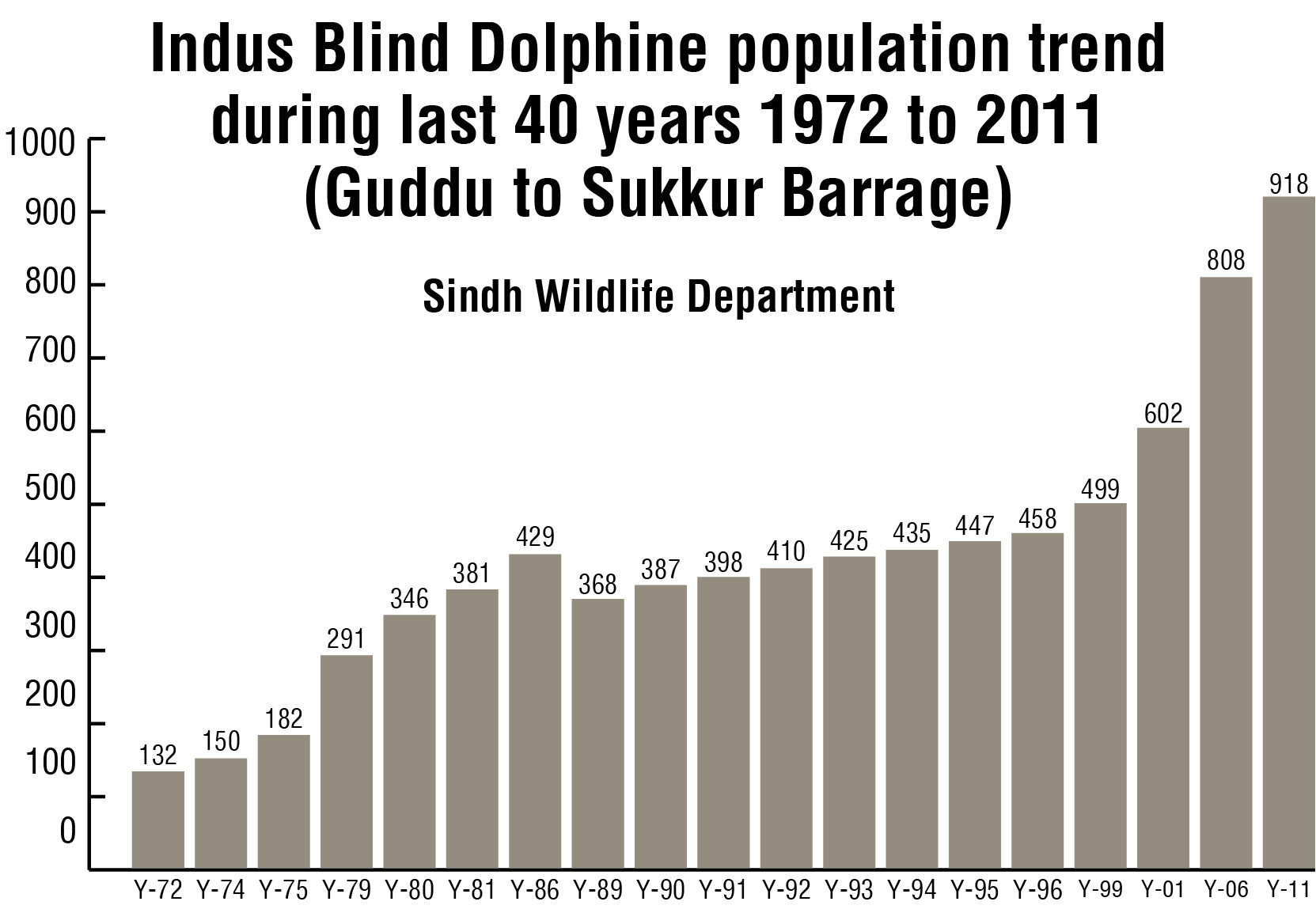
Talpur said the authorities started officially monitoring the numbers of the endangered dolphin with the establishment of the Sindh Wildlife Department in 1972. “The department started routine surveys and since then, we have know the exact numbers of the dolphin in Sindh.”

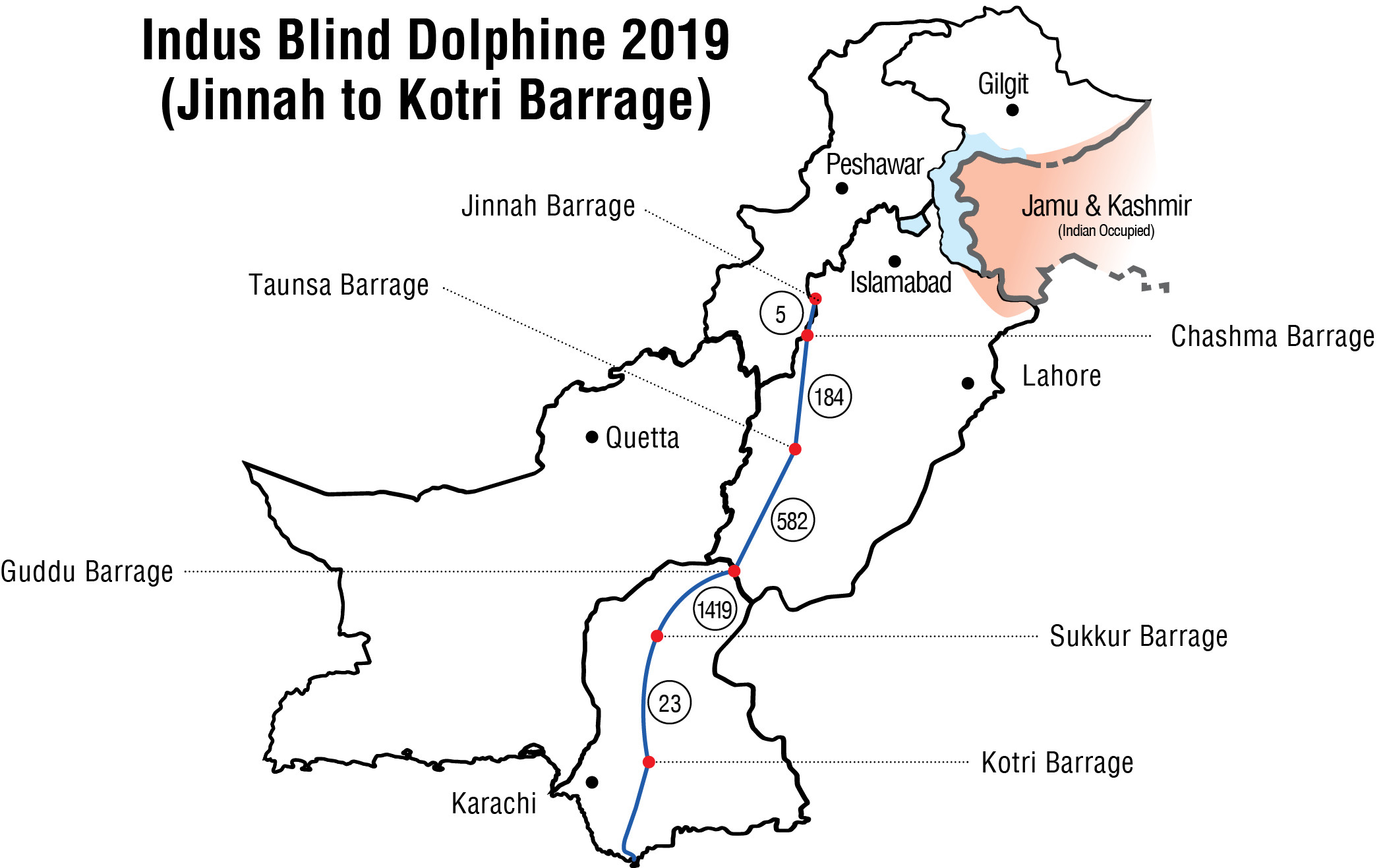
In 1972, when the first survey was carried out, there were just a paltry 132 dolphins in Sindh. “Even so, there has been a steady increase ever since,” Talpur shared. “A 1975 survey showed the numbers had grown to 182. When the last survey was conducted in 2019, we found there were 1,419 river dolphins between the Guddu and Kotri barrages.”

World Wildlife Fund’s (WWF) Project Manager for Sukkur Mohammad Imran Malik said that his organisation’s own independent surveys and rescue operations supported the steady rise in dolphin numbers. “Our results have consistently indicated an increase in this endangered species’ population. We know the numbers have been growing since 2001 and it is quite possible this trend began in the 1970s, when the hunting of this animal was banned,” he said.

Sharing the results of their latest survey, Malik said dolphin abundance was increasing between the Chashma and Taunsa barrages, a range where the species population was previously thought to be stable. “Direct counting results for the sub-population between Chashma and Taunsa barrages were 84, 82, 87 and 170 for the years 2001, 2006, 2011 and 2017 respectively,” he shared. “Between Taunsa and Guddu, similarly, direct counts have been steadily rising from 259 in 2001, to 465 in 2011 and 571 in 2017.”

“The last sub-population surveyed between Guddu and Sukkur barrages, which historically hosted the highest population of the Indus River dolphin also indicated a similar significant increase in population from 602 in 2001 to 1,075 in 2017,” Malik added.


Fruits of collective effort


Dolphine-Chart1624768911-0.jpg


According to Talpur, the fishing communities living along the banks of the Indus, particularly the Hindu Bagri community, used to hunt the dolphins back in the day to extract oil from its fat. “They used this oil to cook food, but an awareness campaign initiated by the Sindh Wildlife Department and WWF convinced them and other stakeholders to start taking care of the endangered species,” he said. “Because of this extensive work, members of the riverside communities immediately inform concerned officials if they sight a dead or stranded dolphin,” he added.

WWF’s Malik provided further detail on this participatory approach to wildlife conservation. “We integrate research and effective law enforcement with stakeholder and community engagement,” he said. “Our joint dolphin rescue programme with the Sindh Wildlife Department has been in place since 1992 and has been very effective in rescuing any stranded or trapped dolphins,” he added. Sharing rescue figures, Malik revealed that 131 out 147 stranded dolphins were saved and released back into the river between 1992 and 2017.

“Only one specimen could not survive the rescue operation, while 33 could not be rescued at all.”
WWF and the Sindh Wildlife Department have also established a dolphin-monitoring network in collaboration with relevant stakeholders and local communities to monitor the Indus River and adjacent canals and tributaries to save dolphins from other hazards.

“The monitoring teams of this network have conducted over 100 monitoring surveys since 2015 to stop illegal fishing and to rescue stranded dolphins with 12 successful rescues during 2016.”

Talking about the steps taken to protect the endangered species, Malik said that a 24-hour phone helpline has been set up to report any stranded dolphins. “The observed increase in the population may be an outcome of all these concrete and continuous efforts,” he said.

Threats persist

According to WWF researchers, habitat fragmentation and degradation due to extraction of water in the dry season and pollution are amongst the prime threats faced by the Indus River Dolphin. Since the 1870s the range of the Indus River dolphin has been reduced to one-fifth of its historical range, primarily due to shortage of water caused by agricultural demands and removal of water from the river to supply the extensive irrigation system in Pakistan.

“Barrages across the Indus River hold running water and divert it into an extensive network of irrigation canals emerging from each barrage to fulfill the need of water for agriculture,” shared Malik. “Indus dolphins tend to move to irrigation canals through flow regulator gates, adjacent to barrages throughout the year and when the canals are closed for maintenance, dolphins are stuck in the canals due to sudden water shortage.”

The WWF official said intensive fishing in the core habitat of the Indus dolphin is also one of the key threats to its population with high probability of dolphin mortality from entanglement in fishing nets, especially when they move into easily accessible and heavily fished irrigation canals. “Habitat fragmentation and degradation due to extraction of water in the dry season and pollution are amongst the prime threats faced by the Indus River dolphin,” he added.

“The construction of numerous dams and barrages across the Indus River has led to the fragmentation of the Indus River dolphin population into isolated sub-populations, many of which have been extirpated especially from the upstream reaches of the river,” he concluded.

Talking about the low number of dolphins in Punjab, Talpur claimed that most of the big cities of Punjab are situated at the bank of rivers and all the drainage waste is mercilessly released in the river. “Not only this but industrial waste, especially poisonous waste from tanneries, is extremely hazardous for the fragile mammal,” he said. According to him, in Sindh from Guddu barrage to Sukkur barrage, no big cities exist at the bank of Indus, except for Sukkur.

“Yet another reason is scarcity of water in the upstream and downstream from Guddu to Sukkur barrages,” he added. “Ample water is available throughout the year, which is why majority of the blind Indus dolphins are found between the two barrages. The only time of the year when the dolphins face difficulties in surviving is in January during the closure of barrages for annual repairs and maintenance in January.” During those days, cases of dolphins slipping in the canal in search of food are frequent. Upon reports of trapped dolphins, they are rescued and released in the safety of the river.

Talking about the fragility of the dolphins Malik said, “They suffer heart attacks as soon as they are entangled in the fishing nets. Therefore, the fishermen are educated to immediately make efforts to rescue the mammal to save its life.”

Mehram Ali Mirani, an elderly fisherman, strongly condemned the use of poisonous chemicals by some in his trade. “This practice must be stopped because on the one hand it proves hazardous for the marine life and on the other human beings also fall prey to various diseases after eating those poisonous fish,” he said. “We are born fishermen and our survival is linked to the clean and healthy river. Therefore, I request the fishermen community, not to use chemicals to catch fish,” he said.
 
Dolphin that strayed is moved to sanctuary in Pakistan

Reuters
08 Nov 2021

6188f60686b26.jpg


LARKANA: An endangered grey dolphin twitches its flippers weakly as it lies in a truck speeding towards a sanctuary in Pakistan, while rescuers sprinkle water on the animal to keep its skin moist and save it from dying.

Blind, with a snout equipped with two rows of sharp teeth, the Indus river dolphin strayed from its freshwater home into a busy waterway, and had to be lifted out by rescue staff in the southeastern province of Sindh after they trapped it in nets.

Now they must keep it alive as they race to the sanctuary 82 km (51 miles) away where they can free it.

"We have to try and get it to the river as soon as possible," said Mir Akhtar Hussain Talpur, an official of the provincial wildlife department, which has rescued 10 of the animals this year, eight of them in just the last month.

"When we are taking a rescued dolphin to the river, we have to be very careful," he said.

It was a delicate task to keep the skin wet and foster the animal's impression of being still in the water, while ensuring no fluid entered the blowhole by which it breathes, he added.

The dolphins are being squeezed out of their habitat after human activity, from dams for irrigation projects to pollution, penned them into a 1,200-km (750-mile) stretch of Pakistan's Indus river, or just half their original range.

Living for millions of years in the turbid waters, the mammals, just one of four surviving freshwater species, eventually went blind and use echolocation, or a form of sonar, for navigation.

They can grow to a length of more than two metres (2 yards) and exceed 100 kg (220 lb) in weight, feeding on catfish, carp and prawns, but need waters at least a metre deep to keep alive.

Some smaller animals stray into shallow irrigation canals, ponds and even fields, where they cannot survive. Although hunting them is banned, Sindh wildlife officials say that getting entangled in fishing nets remains a key threat.

But protection efforts have paid off, with numbers rebounding to 1,816 in 2019, up by half from 2001, a WWF survey showed. That was a far cry from the figure of 132 in 1972 that brought endangered status, leading to creation of the sanctuary.

About 30 animals have died in the roughly 200 rescue efforts Pakistan has launched since 1992. But all 27 rescues after 2019 have succeeded.
 
Our Guest Birds are here to enjoy not to die.
Pease Ban on hunting.

In every winter thousands of migratory birds like these beautiful flamingos come from as far as Siberia to this lake near village Sankar in Tharparkar Desert of Sindh
 
LHC forms committee to examine wildlife possession laws

CJP's daughter challenges act which allows keeping wildlife animals as pets


Rana Yasif
November 10, 2021

LAHORE: Justice Jawad Hassan of the Lahore High Court (LHC) formed a committee on Wednesday to examine the loopholes in laws that allow keeping wild animals as pets.

Justice Jawad was hearing a petition – filed by the daughter of the Chief Justice of Pakistan Gulzar Ahmed – that challenged Section 12 of the Punjab Wildlife Act 1974, through which wild animals were deprived of their natural habitats and kept in confinement.

The wildlife secretary will lead the committee, Justice Jawad stated, adding that the court would alter the act if need be.

During the proceedings, a wildlife officer told the court that no one issued the license to keep wild animals at home and that licenses were issued only for those animals which could easily be looked after at homes.

The petitioners, Sanita Gulzar and Syed Muhammad Ghazenfur filed the petition making the provincial government, wildlife department secretary, World Wildlife Fund-Pakistan (WWF) president and Ministry of Climate Change as respondents.

She maintained that due to Section 12 wild animals have been unnecessarily deprived and kept in confined spaces for the mere entertainment of humans, with little to no supervision from the concerned authorities.

Sanita further highlighted that the wild animals were often tortured, mistreated, starved, mishandled, drugged, agitated and exposed to bad living conditions, which is detrimental for their mental and physical well-being. Resultantly, the fundamental right to liberty – enshrined under Article 9 of the Constitution – of these wild animals is unjustifiably infringed.

She added that the right to life and liberty as written in Article 9 has been interpreted to extend beyond human beings and apply to animals in general as well.

Sanita stated that the respondent province of Punjab has more than 200 breeding farms across the province and more than 20 specialise in breeding exotic tigers and other big cats. Over the past five years, Pakistan has imported more than 85 big cats including pumas, tigers, lions and leopards to name a few. Out of the total, 15 ended up as trophies for hunters.

According to the respondent WWF, a leading organisation in wildlife conservation, the factors stated above played a significant role in shrinking the population of tigers globally.

Quoting some examples of the video clips which went viral, Sanita said that two lions met a terrible fate at the hands of unprofessional animal caretakers as they died while being transferred to a private lion farm.

She implored the court to declare that Section 12 of the Act is ultra vires the Constitution, and that it infringes upon the rights enshrined under Article 9 and Article 14 of the Constitution.

She further asked the court to suspend the operation of Sections 12 (b) prohibit respondent (no-2) from issuing licenses under the Act.

Section 12(1) states that "Certificate of lawful possession: 12 (1) No person shall be in possession of any wild animal unless he be in possession of a certificate of lawful possession granted in respect thereof by the officer authorized in this behalf.

"Provided that any person importing any wild animal, trophy or meat of a wild animal of a kind specified in the Second Schedule in accordance with the provisions of this Act or acquiring such animal, trophy or meat in accordance with the terms of a permit issued under this Act shall apply to the authorized officer for such certificate within thirty days from the date of importing or acquiring the animal, trophy or meat.”
 

Latest Posts

Back